




 Published on : 25/05/2026
£788 Billion Dirty Money Report: Is London the Real Problem, Not Jersey?
The Finance Innovation Lab has published a new report [the report] titled "The UK's Dirty Money Problem: Estimating the Scale of Illicit Flows in the UK Financial System" (May 2026).
However, I'm annoyed that Jersey is being tarnished with a headline that is misleading.
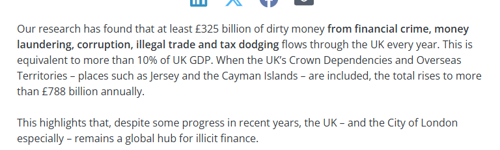
As a reader of the report will determine, this is fundamentally a London problem.
- Crown Dependencies and Overseas Territories are included due to their close integration with the UK, but the report does not provide granular, jurisdiction-specific evidence of wrongdoing.
- The Finance Innovation Lab’s new report focuses overwhelmingly on the role of the UK financial system, particularly the City of London, as a global hub for illicit finance.
- The report’s core estimates and conclusions centre on activity flowing through the UK itself.
- The report estimates that
- £325 billion of illicit financial flows pass through the UK financial system annually — equivalent to more than 10% of UK GDP.
- Rising to £788 billion when Crown Dependencies and Overseas Territories are included.
Overall Balanced Assessment
- The report usefully draws attention to the real and persistent challenges of economic crime, tax leakage, and financial secrecy linked to the UK and its territories.
- However, the headline figures (£325bn / £788bn) should be treated as order-of-magnitude illustrations rather than definitive, audited totals.
- They combine different types of flows (some criminal, some regulatory/tax optimisation) and rely on assumptions that are open to debate.
- The report is advocacy-oriented; it seeks to build momentum for stronger action at the upcoming summit rather than a neutral academic analysis.
- This report provides a useful (if imperfect) spotlight on the issue and rightly calls for better data and coordinated responses, but readers should approach the specific numbers with appropriate caution regarding their precision and framing.
Here is a balanced executive summary and assessment of the report's content.
Overview
- This report from the Finance Innovation Lab estimates the scale of illicit financial flows (IFFs) connected to the UK financial system.
- It aims to inform policy discussions ahead of the UK's 2026 Illicit Finance Summit by highlighting the UK's exposure to dirty money from tax abuse, money laundering, corruption, and related activities.
- The report argues that the City of London and associated jurisdictions remain a significant global hub for illicit finance, despite some progress in transparency.
Key Estimates
- Core UK estimate: Approximately £325 billion per year in illicit financial flows through the UK financial system (2025 values). This is equivalent to roughly 10% of UK GDP.
- Expanded estimate (including Crown Dependencies such as Jersey, Guernsey, and the Isle of Man, plus Overseas Territories such as the Cayman Islands and British Virgin Islands): £788 billion annually.
Breakdown of major components (primarily from Tax Justice Network data):
- Illicit tax and commercial practices: The largest share, including hidden profit shifting by multinationals and offshore wealth income.
- Money laundering proxy (covering illegal markets, corruption, exploitation, etc.): £124 billion (National Crime Agency estimate).
What the Report Actually Highlights
Constructive Aspects:
- It aggregates existing official and independent data sources into a single, accessible overview.
- Emphasises legitimate concerns about financial secrecy, corporate profit shifting, and the challenges of policing modern financial systems.
- Acknowledges the UK's important role as a global financial centre and the economic benefits this brings.
- Calls for better data collection, improved transparency (especially in Crown Dependencies and Overseas Territories), and stronger enforcement resourcing.
- Recognises methodological difficulties in measuring hidden activities.
Important Limitations and Caveats:
- The figures are broad estimates, not precise measurements.
- The report itself stresses they are conservative but acknowledges significant uncertainties, potential double-counting, and reliance on imperfect proxies.
- Heavy dependence on the Tax Justice Network, an advocacy group with a strong policy agenda against tax havens.
- Their methodologies (e.g., profit misalignment, offshore wealth assumptions) are debated in academic and policy circles.
- The £124 billion money laundering figure is an older, updated NCA estimate used as a broad proxy.
- The UN definition of "illicit" used in the report includes aggressive (but often legal) tax avoidance alongside clearly criminal activity, which blurs the line between evasion and avoidance.
- Crown Dependencies and Overseas Territories are included due to their close integration with the UK, but the report does not provide granular, jurisdiction-specific evidence of wrongdoing.
Does the Report Single Out Jersey?
- No. The report does not single out Jersey by name as a specific "contributor to money laundering."
- Instead, it groups Jersey (along with Guernsey and the Isle of Man) under the Crown Dependencies category.
- It assigns them a share of estimated illicit financial flows as part of the broader UK-linked financial ecosystem.
How the Report Justifies Including Crown Dependencies (e.g. Jersey):
- Their financial systems are "deeply intertwined with the City of London."
- UK responsibility for defence and international relations.
- Tax Justice Network estimates attributed to Crown Dependencies:
- £57.7 billion (hidden profit shifting) +
- £10.2 billion (offshore wealth income).
- Use of the UK-wide £124 billion money laundering proxy.
- The report frames this as systemic UK responsibility rather than isolated wrongdoing in any specific territory.
Overall Balanced Assessment
- The report usefully draws attention to the real and persistent challenges of economic crime, tax leakage, and financial secrecy linked to the UK and its territories. Improving transparency and enforcement is a legitimate policy goal.
- However, the headline figures (£325bn / £788bn) should be treated as order-of-magnitude illustrations rather than definitive, audited totals.
- They combine different types of flows (some criminal, some regulatory/tax optimisation) and rely on assumptions that are open to debate.
- The report is advocacy-oriented; it seeks to build momentum for stronger action at the upcoming summit rather than a neutral academic analysis.
Bottom line:
- The UK does face significant illicit finance risks as a major financial centre.
- This report provides a useful (if imperfect) spotlight on the issue and rightly calls for better data and coordinated responses, but readers should approach the specific numbers with appropriate caution regarding their precision and framing.
Sources
- Finance Innovation Lab (May 2026). The UK's Dirty Money Problem: Estimating the Scale of Illicit Flows in the UK Financial System.
- https://financeinnovationlab.org/insights/uk-dirty-money-problem/
The Team
Meet the team of industry experts behind Comsure
Find out moreLatest News
Keep up to date with the very latest news from Comsure
Find out moreGallery
View our latest imagery from our news and work
Find out moreNews Disclaimer
As well as owning and publishing Comsure's copyrighted works, Comsure wishes to use the copyright-protected works of others. To do so, Comsure is applying for exemptions in the UK copyright law. There are certain very specific situations where Comsure is permitted to do so without seeking permission from the owner. These exemptions are in the copyright sections of the Copyright, Designs and Patents Act 1988 (as amended)[www.gov.UK/government/publications/copyright-acts-and-related-laws]. Many situations allow for Comsure to apply for exemptions. These include 1] Non-commercial research and private study, 2] Criticism, review and reporting of current events, 3] the copying of works in any medium as long as the use is to illustrate a point. 4] no posting is for commercial purposes [payment]. (for a full list of exemptions, please read here www.gov.uk/guidance/exceptions-to-copyright]. Concerning the exceptions, Comsure will acknowledge the work of the source author by providing a link to the source material. Comsure claims no ownership of non-Comsure content. The non-Comsure articles posted on the Comsure website are deemed important, relevant, and newsworthy to a Comsure audience (e.g. regulated financial services and professional firms [DNFSBs]). Comsure does not wish to take any credit for the publication, and the publication can be read in full in its original form if you click the articles link that always accompanies the news item. Also, Comsure does not seek any payment for highlighting these important articles. If you want any article removed, Comsure will automatically do so on a reasonable request if you email info@comsuregroup.com.
Archived News
To find our older articles, please click here.
View archive

To find our older articles, please click here.