

A Succinct Guide to “AI” in Third-Party Due Diligence
25/02/2026
I was interested in an XAPIEN publication that claims to be a definitive guide to future-ready third-party due diligence for those who want to modernise third-party risk management without compromising on speed, accuracy, rigour, or control.
- The guide is in 3 parts, and Part 1 is out now.
- Part 1 offers
- A practical framework for adopting AI safely in compliance-grade workflows, covering real-world use cases, risk-based processes, and why explainability is now essential.
The following are Comsure’s key takeaways from part 1
Comsure’s key takeaways of part 1 - Demystifying AI's Role in TPDD and Related Workflows
Key AI Definitions in the guide
- General-Purpose AI (e.g., ChatGPT, Copilot): Probabilistic models for creative tasks; prioritise plausibility over accuracy.
- Purpose-Built AI (e.g., Xapien): Engineered for compliance; uses entity disambiguation and verifiable sources for deterministic, audit-ready outputs.
- Explainability: Trace every finding to a source, ensuring reliability and regulatory defensibility.
This guide:
- Draws on expert insights from
- Leaders at Mintz Group, Fulcrum Diligence, and EY,
- Alongside regulatory analysis from the US DOJ, UK FCA, and EU AI Act,
- A case study to illustrate best practices.
- Is targeted at Chief Compliance Officers, Heads of Risk, and Third-Party Risk Managers, and it demystifies AI's role in
- Third-Party Due Diligence (TPDD),
- SCDD (supply chain scrutiny),
- KYC (client verification), and
- AML (financial crime detection),
- Warns against generic tools while advocating for purpose-built solutions to achieve resilient, future-ready programs.
- Show how AI
- Transforms TPDD by automating data-intensive tasks,
- Enabling faster onboarding,
- Broader coverage, and
- Lower costs while maintaining regulatory confidence.
- Emphasises governance, technology, and operations to manage risks from agents, distributors, partners, and suppliers.
- Reminds us that AI
- Excels in summarisation and triage
- Cannot replace human intuition for cultural context or physical audits.
Meaning of summarisation and triage
Summarisation
- AI can quickly read large amounts of text—emails, documents, reports, chats—and turn them into short, clear summaries.
- Example:
- Long email thread → short bullet points
- 50-page report → key themes in a paragraph
- Meeting transcript → action points + decisions
Triage
- “Triage” means sorting, prioritising, or categorising information so the most important things get attention first.
- AI can, for example:
- Identify which emails are urgent
- Sort client queries by risk level
- Flag documents needing immediate review
- Categorise cases into “high”, “medium”, or “low” priority
In simple terms
AI is very good at:
- Understanding large amounts of information,
- Condensing it, and
- Telling you what needs attention first.
AI in a Risk-Based Workflow
Adopt a tiered approach matching scrutiny to risk levels (e.g., jurisdiction, industry, contract size).
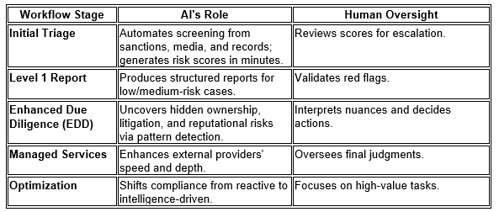
Pitfalls of Generic Tools and Advocacy for Purpose-Built Solutions
Generic AI (e.g., LLMs) introduces risks incompatible with compliance-grade due diligence, as Emily Morgan, Xapien's Global Partnerships Director, notes:
- "General-purpose LLMs are brilliant at conversation, but... in due diligence, that's a risk you can't take."
Key Pitfalls of Generic AI
- Hallucinations: Fabricates plausible but false info, e.g., misleading red flags.
- Black-Box Opacity: Lacks traceable logic, failing DOJ's ECCP (2024) requirements for oversight.
- Inconsistency: Variable outputs undermine equitable risk assessment.
- Data Limitations: Relies on OSINT; risks security breaches and ignores premium sources like corporate records.
- Regulatory Non-Compliance: Cannot meet explainability standards under FCA (2025) or EU AI Act (high-risk systems need human oversight, data governance).
In contrast, purpose-built platforms like Xapien address these:
- Accuracy & Reliability: Entity disambiguation avoids false positives; live sources ensure comprehensiveness.
- Compliance-Grade Features: Fully cited reports, audit trails, and API integrations for seamless workflows.
- Data Security: Custom retention, vetted suppliers exclude customer data from training.
- Scalability: Enterprise tools like multi-user controls and governance meet DOJ/ERM integration.
Expert Russell Corn, CEO of Fulcrum Diligence, emphasises:
- "Transparency and auditability are now baseline regulatory expectations. Black-box tools don’t meet that test."
Regulatory Analysis: Global Expectations
- Regulators demand governed AI without exemptions:
- US DOJ ECCP (2024): Integrate AI into ERM; ensure monitoring, human baselines, and trustworthiness.
- UK FCA (2025): Principles-based; apply existing frameworks for flexibility and outcomes.
- EU AI Act: Risk-based; high-risk TPDD tools require oversight, transparency, and record-keeping.
- Implications: Document controls, test outputs, and prove defensibility. As Yehia Mokhtar of Mintz Group warns: "Accountability doesn't disappear just because a machine is involved."
Build vs Partner Decision
- Build: For organisations with in-house expertise and funding, it offers customisation but high maintenance.
- Partner: Faster, shared accountability; ideal for most. Select based on transparency, maturity, integration, governance, and flexible contracts (per EY's Nicola Mollat: "Cut through the buzzwords. Don't buy the promise, buy the outcome.").
Roadmap for AI Adoption
- Identify Purpose: Solve specific issues like triage speed.
- Map Value: Target data-heavy tasks, not judgment calls.
- Govern: Document oversight tied to regulations.
- Partner Wisely: Prioritise reliable, transparent vendors.
- Adopt Practically: Train teams, integrate workflows.
Conclusion
- Uncompromised due diligence means using AI responsibly—avoiding generic pitfalls with purpose-built solutions that deliver traceable, scalable insights.
Source
The Team
Meet the team of industry experts behind Comsure
Find out moreLatest News
Keep up to date with the very latest news from Comsure
Find out moreGallery
View our latest imagery from our news and work
Find out moreContact
Think we can help you and your business? Chat to us today
Get In TouchNews Disclaimer
As well as owning and publishing Comsure's copyrighted works, Comsure wishes to use the copyright-protected works of others. To do so, Comsure is applying for exemptions in the UK copyright law. There are certain very specific situations where Comsure is permitted to do so without seeking permission from the owner. These exemptions are in the copyright sections of the Copyright, Designs and Patents Act 1988 (as amended)[www.gov.UK/government/publications/copyright-acts-and-related-laws]. Many situations allow for Comsure to apply for exemptions. These include 1] Non-commercial research and private study, 2] Criticism, review and reporting of current events, 3] the copying of works in any medium as long as the use is to illustrate a point. 4] no posting is for commercial purposes [payment]. (for a full list of exemptions, please read here www.gov.uk/guidance/exceptions-to-copyright]. Concerning the exceptions, Comsure will acknowledge the work of the source author by providing a link to the source material. Comsure claims no ownership of non-Comsure content. The non-Comsure articles posted on the Comsure website are deemed important, relevant, and newsworthy to a Comsure audience (e.g. regulated financial services and professional firms [DNFSBs]). Comsure does not wish to take any credit for the publication, and the publication can be read in full in its original form if you click the articles link that always accompanies the news item. Also, Comsure does not seek any payment for highlighting these important articles. If you want any article removed, Comsure will automatically do so on a reasonable request if you email info@comsuregroup.com.


As well as owning and publishing Comsure's copyrighted works, Comsure wishes to use the copyright-protected works of others. To do so, Comsure is applying for exemptions in the UK copyright law. There are certain very specific situations where Comsure is permitted to do so without seeking permission from the owner. These exemptions are in the copyright sections of the Copyright, Designs and Patents Act 1988 (as amended)[www.gov.UK/government/publications/copyright-acts-and-related-laws]. Many situations allow for Comsure to apply for exemptions. These include 1] Non-commercial research and private study, 2] Criticism, review and reporting of current events, 3] the copying of works in any medium as long as the use is to illustrate a point. 4] no posting is for commercial purposes [payment]. (for a full list of exemptions, please read here www.gov.uk/guidance/exceptions-to-copyright]. Concerning the exceptions, Comsure will acknowledge the work of the source author by providing a link to the source material. Comsure claims no ownership of non-Comsure content. The non-Comsure articles posted on the Comsure website are deemed important, relevant, and newsworthy to a Comsure audience (e.g. regulated financial services and professional firms [DNFSBs]). Comsure does not wish to take any credit for the publication, and the publication can be read in full in its original form if you click the articles link that always accompanies the news item. Also, Comsure does not seek any payment for highlighting these important articles. If you want any article removed, Comsure will automatically do so on a reasonable request if you email info@comsuregroup.com.