

An analysis of the power of summary forfeiture in Jersey
05/02/2026
The following paper aims to analyse the core provisions of the Forfeiture of Assets (Civil Proceedings) (Jersey) Law 2018.
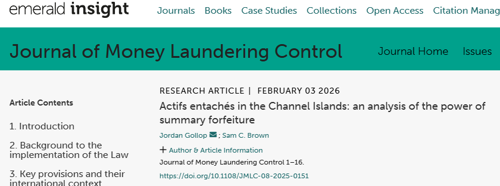
THE PAPER AUTHORED BY JORDAN GOLLOP AND SAM C. BROWN
- Focuses on the effectiveness of the power of summary forfeiture against movable property in both the context of non-conviction-based forfeiture and Jersey’s alignment with international standards.
- Seeks to demonstrate the effectiveness of the power, how it has been challenged and how those challenges have been overcome.
- Highlights areas of potential reform to improve Jersey’s already established reputation in civil asset recovery, and protect the services of international finance centres against abuse as a transit jurisdiction for illicit finance
- Highlights an increasingly important tool in the fight against financial crime in Jersey and beyond.
- Evaluates domestic case law up to the appellate level, exploring judicial analysis of the key provisions and principles to assess whether summary forfeiture achieves legislative objectives and meets international standards.
THE PAPER FINDINGS
- The effectiveness of summary forfeiture can be undermined by extensive litigation.
- Jersey has made significant contributions in this field, which supports the arguments in favour of civil forfeiture powers.
- The Jersey judgments have considered and resolved a wide range of complex issues relevant to coordinate forfeiture regimes.
- The structure of the Law could be changed to enhance both its domestic and international impacts.
THE PAPER CAN BE USED BY OTHERS
- Broader lessons for jurisdictions using non-conviction-based forfeiture and can be used to gain greater insights and awareness into how an international finance centre can enhance civil asset recovery as an alternative to conventional criminal justice measures.
The paper is £29.00

https://www.emerald.com/store/cart
Jordan Gollop Corresponding Author; Sam C. Brown
Journal of Money Laundering Control 1–16.
The Team
Meet the team of industry experts behind Comsure
Find out moreLatest News
Keep up to date with the very latest news from Comsure
Find out moreGallery
View our latest imagery from our news and work
Find out moreContact
Think we can help you and your business? Chat to us today
Get In TouchNews Disclaimer
As well as owning and publishing Comsure's copyrighted works, Comsure wishes to use the copyright-protected works of others. To do so, Comsure is applying for exemptions in the UK copyright law. There are certain very specific situations where Comsure is permitted to do so without seeking permission from the owner. These exemptions are in the copyright sections of the Copyright, Designs and Patents Act 1988 (as amended)[www.gov.UK/government/publications/copyright-acts-and-related-laws]. Many situations allow for Comsure to apply for exemptions. These include 1] Non-commercial research and private study, 2] Criticism, review and reporting of current events, 3] the copying of works in any medium as long as the use is to illustrate a point. 4] no posting is for commercial purposes [payment]. (for a full list of exemptions, please read here www.gov.uk/guidance/exceptions-to-copyright]. Concerning the exceptions, Comsure will acknowledge the work of the source author by providing a link to the source material. Comsure claims no ownership of non-Comsure content. The non-Comsure articles posted on the Comsure website are deemed important, relevant, and newsworthy to a Comsure audience (e.g. regulated financial services and professional firms [DNFSBs]). Comsure does not wish to take any credit for the publication, and the publication can be read in full in its original form if you click the articles link that always accompanies the news item. Also, Comsure does not seek any payment for highlighting these important articles. If you want any article removed, Comsure will automatically do so on a reasonable request if you email info@comsuregroup.com.


As well as owning and publishing Comsure's copyrighted works, Comsure wishes to use the copyright-protected works of others. To do so, Comsure is applying for exemptions in the UK copyright law. There are certain very specific situations where Comsure is permitted to do so without seeking permission from the owner. These exemptions are in the copyright sections of the Copyright, Designs and Patents Act 1988 (as amended)[www.gov.UK/government/publications/copyright-acts-and-related-laws]. Many situations allow for Comsure to apply for exemptions. These include 1] Non-commercial research and private study, 2] Criticism, review and reporting of current events, 3] the copying of works in any medium as long as the use is to illustrate a point. 4] no posting is for commercial purposes [payment]. (for a full list of exemptions, please read here www.gov.uk/guidance/exceptions-to-copyright]. Concerning the exceptions, Comsure will acknowledge the work of the source author by providing a link to the source material. Comsure claims no ownership of non-Comsure content. The non-Comsure articles posted on the Comsure website are deemed important, relevant, and newsworthy to a Comsure audience (e.g. regulated financial services and professional firms [DNFSBs]). Comsure does not wish to take any credit for the publication, and the publication can be read in full in its original form if you click the articles link that always accompanies the news item. Also, Comsure does not seek any payment for highlighting these important articles. If you want any article removed, Comsure will automatically do so on a reasonable request if you email info@comsuregroup.com.