



 Published on : 14/05/2026
ASK MAT: feedback on Comsure training on higher risk countries facilitating terrorist financing (TF).
Today, Comsure received the following ASK MAT:-
Hi Mat, I have some Feedback on today's Comsure training on countries that may pose a higher risk of facilitating terrorist financing (TF).
Today, you presented an excellent workshop on those countries that may pose a higher risk of facilitating terrorist financing (TF).
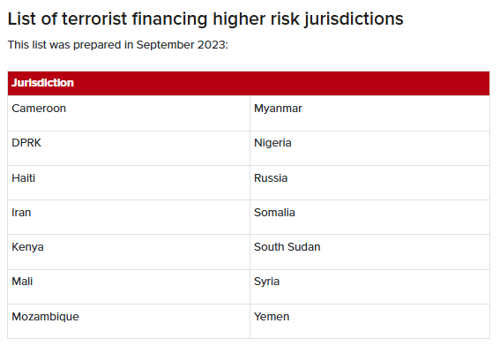
Given the time of the workshop, you weren't able to explain why the Jersey list of countries that may present a higher risk of facilitating terrorist financing (TF) is so out of date, as shown in the image below.
As you suggested at the workshop, could you please provide a blog post on the 2023 and your unofficial lists, based on up-to-date data?
MAT SAYS
- Thank you for the feedback, and yes, today's workshop offered plenty of debate about maintaining up-to-date information when assessing risk and not always relying on the government and on our regulators
Context and Original Methodology
- The list above is based on Jersey's 2023 TF National Risk Assessment, drawing on FATF evaluations, open-source indices, local Suspicious Activity Reports (SARs), and threat intelligence.
- It supplements JFSC Appendices D1 (FATF call-for-action/blocklist) and D2 (broader, higher-risk countries).
2023 LIST ASSESSMENT
- Jersey's September 2023 List of Terrorist Financing (TF) Higher Risk Jurisdictions
- Remains a solid, risk-based tool tailored to an international financial centre's (IFC) exposures, focusing on jurisdictions with elevated TF threats relevant to banking, remittances, trade, and non-profits.
- Aligns well with FATF standards by prioritising core high-risk countries (DPRK, Iran, Myanmar) and conflict/hotspot zones while encouraging proportionate Enhanced Due Diligence (EDD) rather than automatic de-risking.
- Strengths
- include transparency, practicality, and comprehensive coverage of persistent TF risks across the Horn of Africa, the Sahel, and the Middle East.
- Weaknesses
- Centre on its age: several listed countries (e.g., Nigeria, Mozambique, Mali) exited FATF increased monitoring in 2025 after reforms,
- while new or evolving risks (e.g., Lebanon, cyber-enabled TF) are underrepresented.
- Russia's inclusion appears to be driven by geopolitics rather than by TF alone.
2026 LIST ASSESSMENT
- As of mid-2026, the list is somewhat outdated and could benefit from annual (or ad-hoc) refreshes tied to FATF plenaries.
2026/27 MONEYVAL RISK
- To maintain credibility and avoid unintended de-risking or compliance fatigue.
- The refreshed 2026 version should retain the core while removing improved jurisdictions and adding emerging threats to improve precision.
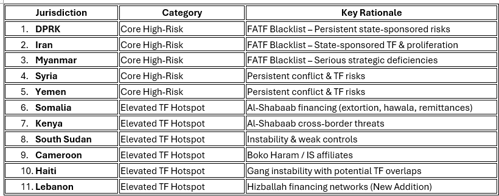
MATS Proposed 2026 Jersey TF Higher Risk Jurisdictions List (reflecting February 2026 FATF updates and ongoing global TF threats):
My list is impacted as follows
- Core High-Risk (Retain – FATF Blacklist + Persistent State-Sponsored/Conflict TF):
- DPRK
- Iran
- Myanmar
- Syria
- Yemen
- Elevated TF Hotspots (Retain or Add – Active Groups, Weak Controls, Remittance/Conflict Risks):
- Somalia (Al-Shabaab financing remains acute)
- Kenya (Al-Shabaab cross-border threats)
- South Sudan (instability, grey list)
- Cameroon (Boko Haram/IS affiliates; still on grey list)
- Haiti (instability/gangs with potential TF overlaps; grey list)
- Lebanon (New emphasis: Hizballah financing networks – major gap in 2023 list)
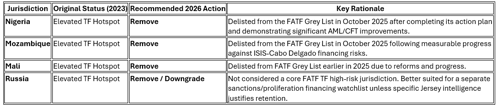
- Remove or Downgrade:
- Nigeria — Removed from the FATF grey list in October 2025 after completing its action plan; measurable AML/CFT improvements.
- Mozambique — Removed October 2025; progress against ISIS-Cabo Delgado financing.
- Mali — Removed June 2025.
- Russia — Retain only if Jersey-specific intelligence (e.g., sanctions evasion links to designated groups) justifies it; otherwise, remove or move to a separate sanctions/proliferation list. Not a core FATF TF high-risk jurisdiction.
- Potential Additions (Emerging or Under-Represented):
- Lebanon (as noted – Hizballah)
- Afghanistan (Taliban governance + ISIS-K financing via hawala/crypto)
- Burkina Faso or other Sahel states if risks escalate (though some progress noted)
- Monitor
- Kuwait and Papua New Guinea (new grey list additions Feb 2026) for any TF relevance, but not automatic inclusion.
MATS Final Remaining Countries Table
- Total remaining jurisdictions: 11
- This streamlined table shows only the countries that should remain on Jersey's TF Higher Risk list in the proposed 2026 update.
- Removals (Nigeria, Mozambique, Mali, Russia) have been excluded as per the earlier analysis.
- The list is now more focused, current, and proportionate while still covering the most significant terrorist financing threats relevant to Jersey.
Ones to keep an eye on - Downgraded / Removed Countries Table (From Jersey's Original September 2023 TF Higher Risk List)
Summary
- Total downgraded/removed: 4 countries
- These changes make the 2026 list more accurate, focused, and aligned with current FATF assessments (as of mid-2026).
Rationale for Changes:
- Timeliness & Accuracy: The 2023 list predates significant 2025 FATF delisting (Nigeria, Mozambique, Mali, Burkina Faso, etc.). Retaining them risks overstating current deficiencies and encouraging unnecessary de-risking, which FATF discourages.
- Focus on Actual TF Threat: Prioritise jurisdictions with active terrorist organisations (e.g., Al-Shabaab, ISIS affiliates, Hizballah) over general AML weaknesses. Grey-list status is a useful indicator, but not the sole driver — the inherent TF threat and controls matter more.
- Emerging Risks: Post-2023 developments include greater use of crypto, cyber-financing, and shifting conflict zones. Lebanon's inclusion addresses a notable gap in state-sponsored TF. Afghanistan warrants attention due to Taliban/ISIS-K dynamics.
- Proportionality: Narrower, tiered lists (e.g., Core Black + TF Hotspots) reduce compliance burden while aligning with FATF's risk-based approach and financial inclusion goals.
- Geopolitical Neutrality: Russia's entry likely reflects the 2022–2023 sanctions context; by 2026, separate it from pure TF unless specific evidence persists.
Overall Assessment (Updated)
- Jersey's original list was a proactive step in 2023.
- In 2026, we need to refresh it to remain a credible, dynamic tool.
- Regular public updates (e.g., post-FATF plenaries) plus sector-specific guidance would enhance its utility.
- Financial institutions should still conduct their own risk assessments, using Jersey's list as one input among many.
- This evolution would strengthen Jersey's reputation as a responsible IFC while better balancing TF prevention with legitimate economic flows.
Sources
Original Jersey List (September 2023):
- Official Government of Jersey page: https://www.gov.je/Industry/Finance/FinancialCrime/pages/moneylaunderingterroristfinancing.aspx
- (lists exactly: Cameroon, Myanmar, DPRK, Nigeria, Haiti, Russia, Iran, Somalia, Kenya, South Sudan, Mali, Syria, Mozambique, Yemen).
FATF Black List (High-Risk Jurisdictions subject to Call for Action) – February 2026:
- Still: DPRK, Iran, Myanmar (calls for EDD and countermeasures).
- Official: https://www.fatf-gafi.org/en/publications/High-risk-and-other-monitored-jurisdictions/Call-for-action-february-2026.html
FATF Grey List (Jurisdictions under Increased Monitoring) – February 2026:
- Includes: Cameroon, Haiti, Kenya, South Sudan, Syria, Yemen, Lebanon, and others (full list at link).
- Kuwait and Papua New Guinea added.
- Official: https://www.fatf-gafi.org/en/publications/High-risk-and-other-monitored-jurisdictions/increased-monitoring-february-2026.html
2025 Delistings (Nigeria, Mozambique, etc.):
- Removed October 2025: Nigeria, Mozambique, Burkina Faso, South Africa (and earlier Mali progress).
- Sources:
Jersey FSC Appendix D2 (Higher Risks – updated April 2026):
The Team
Meet the team of industry experts behind Comsure
Find out moreLatest News
Keep up to date with the very latest news from Comsure
Find out moreGallery
View our latest imagery from our news and work
Find out moreNews Disclaimer
As well as owning and publishing Comsure's copyrighted works, Comsure wishes to use the copyright-protected works of others. To do so, Comsure is applying for exemptions in the UK copyright law. There are certain very specific situations where Comsure is permitted to do so without seeking permission from the owner. These exemptions are in the copyright sections of the Copyright, Designs and Patents Act 1988 (as amended)[www.gov.UK/government/publications/copyright-acts-and-related-laws]. Many situations allow for Comsure to apply for exemptions. These include 1] Non-commercial research and private study, 2] Criticism, review and reporting of current events, 3] the copying of works in any medium as long as the use is to illustrate a point. 4] no posting is for commercial purposes [payment]. (for a full list of exemptions, please read here www.gov.uk/guidance/exceptions-to-copyright]. Concerning the exceptions, Comsure will acknowledge the work of the source author by providing a link to the source material. Comsure claims no ownership of non-Comsure content. The non-Comsure articles posted on the Comsure website are deemed important, relevant, and newsworthy to a Comsure audience (e.g. regulated financial services and professional firms [DNFSBs]). Comsure does not wish to take any credit for the publication, and the publication can be read in full in its original form if you click the articles link that always accompanies the news item. Also, Comsure does not seek any payment for highlighting these important articles. If you want any article removed, Comsure will automatically do so on a reasonable request if you email info@comsuregroup.com.
Archived News
To find our older articles, please click here.
View archive

To find our older articles, please click here.