

ASK MAT: Is there one UK sanction list I should be concerned with, or are there two, three, or four
15/02/2026
ASK MAT: Is there one UK sanction list I should be concerned with, or are there two, three, or four
MAT SAYS
Thank you for your question, which I believe relates to the recent development on January 28, 2026, where we were told that the “UK moves to a single sanctions list” The UK Sanctions List (UKSL) will be the only UK government list that details sanctions designations.
The UK's move to a "single sanctions designation list" on 28 January 2026 means that the UK government consolidated all its general sanctions designations restrictions, like asset freezes, travel bans, trade embargoes, and other measures imposed under the Sanctions and Anti-Money Laundering Act 2018, into one official source: the UK Sanctions List (UKSL).
Previously, designations were split across multiple lists (e.g., the UKSL from the Foreign Office and a separate Consolidated List from the Treasury focused only on financial sanctions). This change simplified matters by making the UKSL the sole, comprehensive reference for these designations and closing the Treasury's list.
- This consolidation applies only to ONE general sanctions designation.
- However, there are still THREE other specialised lists that remain separate because they serve distinct purposes under different laws or regulations, and they weren't merged into the UKSL.
So, there are four lists to keep an eye on, as follows:-
- The UK Sanctions List (UKSL) is a general sanctions designations list
- The Russia Investment Ban List (Schedule 2),
- The UK Terrorism Sanctions List, and
- The Proscribed Terrorist Organisations List.
In short, the "general sanctions designations list" consolidates the main sanctions system into a single list (UKSL), while the other three are specialised add-ons for terrorism or specific Russia-related bans, for a total of four distinct lists.
Key features of the for are:-
- These lists impose measures like
- Asset freezes, investment bans, travel restrictions, and criminal prohibitions on membership/support to counter threats from geopolitical aggression, human rights abuses, and terrorism.
- Key overlaps include
- Unified enforcement (primarily by the Office of Financial Sanctions Implementation (OFSI) for financial aspects), mandatory reporting for relevant firms upon exposure, and the extension of sanctions to entities owned or controlled >50% by designated persons (where applicable).
- Distinctions lie in scope.
- Broad for UKSL, economic-focused for Russia, security-oriented for terrorism sanctions, and organisational bans for proscription.
Warning
- Compliance is essential to avoid criminal penalties; report immediately to OFSI or other authorities when knowledge of, or suspicion of, designations or breaches arises.
- This framework demands robust screening and risk management to mitigate exposure.
JERSEY COMPLIANCE NOTES
Jersey mirrors the UK across all four sanctions lists, but with nuances in the implementation of the proscribed list. I've included a key feature breakdown below to clarify the linkage and maintenance for each.
1. UK Sanctions List (UKSL)
- Mirroring: Yes, Jersey fully mirrors the UKSL. All designations (asset freezes, travel bans, etc.) under the UK's Sanctions and Anti-Money Laundering Act 2018 (SAMLA) are automatically implemented in Jersey via "ambulatory" provisions (automatic updates without separate action).
- Local Implementation: Through the Sanctions and Asset-Freezing (Jersey) Law 2019 (SAFL) and Sanctions and Asset-Freezing (Implementation of External Sanctions) (Jersey) Order 2021 (SAFO). No separate Jersey list; changes to UKSL take immediate effect in Jersey.
- Maintenance: Administered by the Jersey Financial Services Commission (JFSC); mirrors the UK without independent Jersey maintenance.
2. Russia Investment Ban List (Schedule 2)
- Mirroring: Yes, Jersey fully mirrors this UK list. The financial and investment prohibitions under the UK's Russia (Sanctions) (EU Exit) Regulations 2019 apply automatically in Jersey.
- Local Implementation: Via SAFL and SAFO, with regime-specific Orders (e.g., for Russia/Belarus reporting). The list remains separate from UKSL, as in the UK.
- Maintenance: No independent Jersey list; updates mirror UK changes automatically.
3. UK Terrorism Sanctions List (Under Terrorism and Counter-Terrorism Regimes)
- Mirroring: Yes, Jersey fully mirrors this. Financial sanctions (e.g., asset freezes) under UK counter-terrorism regimes are automatically implemented.
- Local Implementation: Through SAFL/SAFO for SAMLA-based measures. Integrated into UKSL; Jersey follows UK designations without a separate list.
- Maintenance: Mirrors UK; no independent maintenance.
4. Proscribed Terrorist Organisations List (Under Terrorism Act 2000)
- Mirroring: Yes, Jersey mirrors the UK list, but through a hybrid mechanism:
- It has its own equivalent list in Schedule 1 to the Terrorism (Jersey) Law 2002 (as amended), which is maintained by the Jersey government (Minister for Home Affairs via Orders).
- However, it is directly linked to the UK list.
- Under Article 6(1) of the Terrorism (Jersey) Law 2002, an organisation is proscribed in Jersey if:
- (a) It is listed in Jersey's Schedule 1;
- (b) It operates under the same name as one in Schedule 1; or
- (c) It is proscribed by virtue of or under section 3 of the UK's Terrorism Act 2000.
- This means UK proscriptions under TA 2000 have direct, automatic effect in Jersey without needing a separate Jersey action it's statutorily referenced and linked.
- Schedule 1 (Jersey's own list) is amended periodically by Jersey Orders to reflect UK changes (e.g., additions like Palestine Action in 2025 prompted a Jersey amendment Order), ensuring alignment.
- As of now [Feb 13, 2026], it includes 84 international and 14 Northern Ireland-related groups, matching the UK.
- Local Implementation: Criminalises membership/support/funding under the Terrorism (Jersey) Law 2002 (penalties up to 10-14 years, differing slightly from the UK's 14 years max). Distinct from financial asset freezes (handled via SAMLA/UKSL).
- Maintenance: Primarily by Jersey's Minister for Home Affairs, who issues Orders to update Schedule 1 "to reflect" UK changes. While maintained locally, the direct statutory link via Article 6(1)(c) ensures automatic incorporation of UK proscriptions.
JERSEY SUMMARY,
- Jersey mirrors all four UK lists through local laws designed for alignment (automatic for financial sanctions via SAFL/SAFO; direct statutory reference for proscription).
- The proscribed list is not "not linked directly" it is explicitly linked by law, though Jersey maintains and amends its Schedule 1 to stay in sync.
- This setup reflects Jersey's Crown Dependency status, where it adopts UK foreign policy but enacts it locally.
- For compliance, screen against both UK sources and Jersey Gazette notices for any local Orders.
A BRIEFING ON THE 4 LISTS
Below, I provide an overview of each list, including scope, maintenance, examples, and the legal basis.
1. UK Sanctions List (Central List for Individuals, Entities, and Ships)
This is the comprehensive, authoritative list of all designated persons (individuals and entities) and specified ships subject to UK sanctions across various regimes. It includes measures such as asset freezes (prohibiting dealings with funds or economic resources owned, held, or controlled by designated persons), travel bans (restricting entry or transit through the UK), and other restrictions, such as arms embargoes or trade bans.
- Scope: Covers global regimes, including country-specific ones (e.g., Russia, Iran, North Korea) and thematic ones (e.g., human rights, cyber-attacks). Designations are based on criteria like involvement in threats to UK national security, international peace, or human rights violations.
- Maintenance: Updated by the FCDO and searchable via an online tool. It includes more than 2,000 entries, with details such as names, aliases, addresses, and reasons for designation. Ownership/control rules apply: If a designated person owns or controls more than 50% of an entity (directly or indirectly, through shares, voting rights, board appointment powers, or other means of influence), sanctions extend to that entity.
- Key Example: Includes Russian oligarchs, Iranian officials, and entities linked to North Korean proliferation. Ships may be designated to evade sanctions (e.g., oil tankers).
- Legal Basis: SAMLA and regime-specific regulations (e.g., Russia (Sanctions) (EU Exit) Regulations 2019).
2. Russia Investment Ban List (Schedule 2 of the Russia (Sanctions) (EU Exit) Regulations 2019)
This is a dedicated, targeted list focused on financial and investment restrictions under the UK’s Russia sanctions regime. It identifies "persons" (primarily organisations and entities but can include individuals) subject to prohibitions on dealings in transferable securities or money-market instruments (e.g., bonds, shares with maturity >30 days issued after specific dates), granting loans or credit (>30 days maturity), or entering related financial arrangements. These aim to restrict Russia's access to UK capital markets and financing.
- Scope: Narrower than the central list, emphasising sectoral restrictions on key Russian economic players to curb funding for aggression (e.g., in Ukraine). It does not automatically impose asset freezes unless the entity is also designated on the UKSL.
- Maintenance: Published separately by OFSI as the "Investment Ban Targets" list, with about 10-15 entities (e.g., Sberbank, VTB Bank, Gazprombank, Rosneft, Transneft). Updates are regime-specific and tied to geopolitical events. Ownership/control rules apply: Prohibitions extend to entities owned or controlled by listed persons, using the same >50% threshold defined in Regulation 7.
- Key Example: Prohibits UK persons from providing loans to listed banks or dealing in their securities issued after March 1, 2022. Exceptions may apply via OFSI licenses for humanitarian or divestment purposes.
- Legal Basis: Specifically, Schedule 2 and Chapters 2-3 of the Russia Regulations, with extensions to subsidiaries or controlled entities.
3. UK Terrorism Sanctions List (Under Terrorism and Counter-Terrorism Regimes)
This covers designations related to terrorism, drawing on UK domestic law and UN obligations. It includes individuals, groups, and entities involved in terrorist acts, financing, or support, and subjects them to asset freezes, travel bans, and arms embargoes. The list is integrated into the UKSL but has dedicated sub-regimes for clarity.
- Scope: Focuses on preventing terrorism in the UK or globally. It includes domestic threats (e.g., far-right or Islamist groups) and international ones (e.g., UN-listed ISIL/Da'esh and Al-Qaida affiliates). Prescriptions under the Terrorism Act 2000 ban organisations outright.
- Maintenance: Part of the UKSL, with specific notices for regimes like Counter-Terrorism (Domestic) (under the Counter-Terrorism (Sanctions) (EU Exit) Regulations 2019), Counter-Terrorism (International), and ISIL (Da’esh) and Al-Qaida (UN Sanctions) (EU Exit) Regulations 2019. Around 100-200 entries, updated for new threats. Ownership/control rules apply asset freezes, and other measures extend to entities owned or controlled by designated persons, pursuant to the general >50% rule.
- Key Example: Includes groups like Hezbollah's military wing or individuals funding extremism. UN designations are automatically adopted.
- Legal Basis: Terrorism Act 2000, Anti-Terrorism, Crime and Security Act 2001, and SAMLA-derived regulations.
4. Proscribed Terrorist Organisations List
This is a separate list maintained by the Home Office under the Terrorism Act 2000 (TACT 2000), banning 84 international terrorist organisations and 14 Northern Ireland-related groups (as of December 2025). It deals exclusively with legal entities (organisations/groups) and imposes sanctions-like measures, such as criminalising membership, support, or funding. Proscription is distinct from financial asset freezes under SAMLA (which are in UKSL), though proscribed groups may also face asset freezes if designated under terrorism regimes. This list is not integrated into UKSL and is governed by different legislation (TACT 2000, not SAMLA). It does not designate individual natural persons.
- Scope: Focuses on organisations involved in terrorism, criminalising involvement to disrupt support networks.
- Maintenance: Maintained by the Home Office; updates via statutory instruments requiring Parliamentary approval. Total of 98 entries (84 international + 14 Northern Ireland-related), with reviews as needed.
- Key Example: Includes Al-Qa’ida, Hamas, Hezbollah, Islamic State (Da’esh), and Northern Ireland groups like the Irish Republican Army (IRA).
- Legal Basis: Terrorism Act 2000 (sections 3 and Schedule 2).
Comparison and Contrast of the Lists
The following table compares and contrasts the four lists across key dimensions, including reporting requirements and the application of the >50% ownership/control rule (which extends sanctions to controlled entities where applicable).
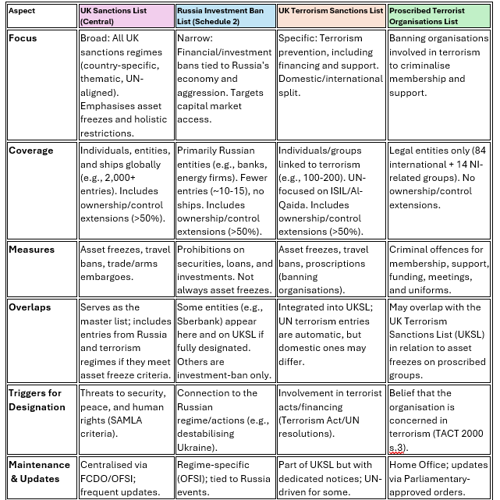
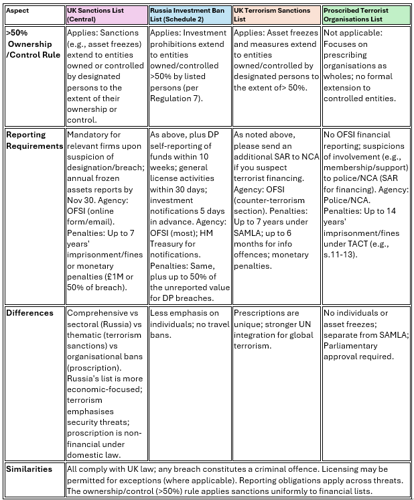
Triggers and Reporting Rules for Exposure to Identifiable Persons on the Lists
Exposure to designated persons triggers immediate compliance actions, including asset freezes and reporting. Obligations primarily apply to "relevant firms" (e.g., financial institutions, lawyers, crypto providers) in the context of financial sanctions. Reports must be filed as soon as practicable upon knowledge or reasonable suspicion.
- General Triggers Across All Lists: Suspicion of designation, breach (e.g., dealing with frozen assets), holding funds/resources, or non-compliance. Annual frozen assets reports by November 30 (for financial lists). Details: Basis of suspicion, identifiers, asset values.
- Consequences: No dealings without a license; penalties up to 7 years' imprisonment/fines or £1M/50% of breach (higher for proscription offences).
Specific Reporting Rules by List
- UK Sanctions List (Central): Triggers as general; report to OFSI via online form or email (ofsi@hmtreasury.gov.uk).
- Russia Investment Ban List: Adds DP self-reporting and investment notifications; report to OFSI/HM Treasury (sanctions@fcdo.gov.uk).
- UK Terrorism Sanctions List: Adds potential SAR to NCA; report to OFSI.
- Proscribed Terrorist Organisations List: Triggers: Knowledge/suspicion of membership, support, or funding. Who Must Report: Anyone (criminal to fail if facilitating offences). Agency: Police (e.g., via 101/999) or NCA (SAR for financing). How: Direct reporting to authorities; no specific form, such as OFSI. Penalties: Up to 14 years' imprisonment/fines under TACT 2000 (e.g., for non-disclosure of information under s.19). Notes: Focuses on criminal reporting, not financial freezes; overlaps with AML SARs if financing is involved.
Conclusion
- The UK's four core sanctions lists form a layered defence against diverse threats, with the UKSL providing broad coverage, the Russia list targeting economic levers, the terrorism sanctions list focusing on financial and security risks, and the proscribed list enforcing outright bans on terrorist organisations.
- Uniform elements, such as the >50% ownership rule (for applicable lists) and authority-led reporting, ensure consistent enforcement, but regime-specific nuances require tailored compliance strategies.
- Boards must prioritise regular screening, training, and license applications to avoid severe penalties.
Comprehensive List of Web Sources Used in UK Sanctions Briefings
Sources are current as of February 13, 2026, based on web searches and prior citations.
Jersey
- Industry update - 28 January 2026 - https://www.jerseyfsc.org/news-and-events/uk-moves-to-a-single-sanctions-list/
Core Sanctions Lists and General Framework
- The UK Sanctions List (Central List): Official page for the comprehensive list of all designated persons, entities, and ships under UK sanctions. This is the sole authoritative source as of January 28, 2026. URL: https://www.gov.uk/government/publications/the-uk-sanctions-list
- UK Sanctions List Search Tool: Interactive tool to search designations by name, regime, or other criteria. URL: https://search-uk-sanctions-list.service.gov.uk/
- Guidance on Moving to a Single UK Sanctions List (January 28, 2026): Details the transition from the OFSI Consolidated List to the UKSL. URL: https://www.gov.uk/guidance/moving-to-a-single-list-for-uk-sanctions-designations-28-january-2026
- UK Financial Sanctions General Guidance: Comprehensive OFSI guidance on sanctions implementation, including ownership/control rules (>50%), licensing, and reporting. URL: https://www.gov.uk/government/publications/financial-sanctions-general-guidance/uk-financial-sanctions-general-guidance
- UK Sanctions Collections Page: Overview of all UK sanctions regimes, noting the UKSL as the sole source after January 28, 2026. URL: https://www.gov.uk/government/collections/uk-sanctions
- OFSI Consolidated List Search (Legacy Tool): Search for financial sanctions targets; superseded by UKSL but useful for historical context. URL: https://sanctionssearchapp.ofsi.hmtreasury.gov.uk/
- Withdrawn: Financial Sanctions Consolidated List of Targets: Legacy list page, noting transition to UKSL. URL: https://www.gov.uk/government/publications/financial-sanctions-consolidated-list-of-targets/consolidated-list-of-targets
- Announcement: Moving to a Single List for UK Sanctions Designations - 28 January 2026: Bulletin on the UKSL transition. URL: https://content.govdelivery.com/accounts/UKORGESO/bulletins/4066c1b
- UK Sanctions Regime Guide (The Law Society): Information on criminal offences, risk assessments, and sanctions lists. URL: https://www.lawsociety.org.uk/en/topics/anti-money-laundering/sanctions-guide
Russia Investment Ban List (Schedule 2)
- Russia Sanctions Guidance: Overview of prohibitions under the Russia regime, including financial and investment restrictions. References Schedule 2 entities. URL: https://www.gov.uk/government/publications/russia-sanctions-guidance/russia-sanctions-guidance
- List of Entities Subject to Financial and Investment Restrictions (Russia): Dedicated list of persons (e.g., Sberbank, VTB) under Schedule 2 prohibitions. URL: https://www.gov.uk/guidance/russia-list-of-persons-named-in-relation-to-financial-and-investment-restrictions
- The Russia (Sanctions) (EU Exit) Regulations 2019 - Schedule 2: Full legal text of Schedule 2, listing the targeted entities. URL: https://www.legislation.gov.uk/uksi/2019/855/schedule/2
UK Terrorism Sanctions List
- Counter-Terrorism: List of Designations and Sanctions Notices: Lists designated persons under counter-terrorism regimes, with notices on updates. Integrated into the UKSL. URL: https://www.gov.uk/guidance/counter-terrorism-list-of-designations-and-sanctions-notices
- UK Sanctions List - Counter-Terrorism Filter: Direct search for counter-terrorism designations within the UKSL. URL: https://search-uk-sanctions-list.service.gov.uk/?regimeNames=Counter-Terrorism+%28Domestic%29&searchValue=%22Counter-Terrorism+%28Domestic%29%22
Proscribed Terrorist Organisations List
- Proscribed Terrorist Groups or Organisations: Official Home Office list of banned terrorist groups under the Terrorism Act 2000, including criteria and updates (last updated January 28, 2026). URL: https://www.gov.uk/government/publications/proscribed-terror-groups-or-organisations--2
- Proscribed Terrorist Groups or Organisations (Accessible Version): Detailed accessible list of proscribed groups, with 84 international and 14 Northern Ireland-related organisations. URL: https://www.gov.uk/government/publications/proscribed-terror-groups-or-organisations--2/proscribed-terrorist-groups-or-organisations-accessible-version
- Proscribed Terrorist Organisations (Parliamentary Research Briefing, December 2025): PDF briefing with list of 84 international and 14 NI groups, including de-proscription details. URL: https://researchbriefings.files.parliament.uk/documents/SN00815/SN00815.pdf
- Proscribed Terrorist Organisations (Commons Library): Updated briefing on proscribed groups, including recent additions like Palestine Action (as of December 2025). URL: https://commonslibrary.parliament.uk/research-briefings/sn00815
- Proscription (Counter Terrorism Policing): Explains proscribed organisations, criteria, and links to the Home Office list. URL: https://www.counterterrorism.police.uk/proscription
- UK Proscribed Terrorist Groups or Organizations (OpenSanctions): Database of proscribed organisations under the Terrorism Act 2000. URL: https://www.opensanctions.org/datasets/gb_proscribed_orgs
- Proscribed Organisations - Membership (Sentencing Council): Guidelines on sentencing for membership offences under the Terrorism Act 2000. URL: https://sentencingcouncil.org.uk/guidelines/proscribed-organisations-membership
Reporting Obligations and Compliance
- Suspected Breach of Financial Sanctions - What to Do: Guidance on reporting exposures, breaches, or suspicions to OFSI, including the online form. URL: https://www.gov.uk/guidance/suspected-breach-of-financial-sanctions-what-to-do
- OFSI Blog: Reporting to OFSI - What Do I Need to Do?: Practical advice on who must report and how. URL: https://ofsi.blog.gov.uk/2022/08/30/reporting-to-ofsi-what-do-i-need-to-do
- OFSI Enforcement Processes (PDF Guidance): Details penalties, processes, and obligations for breaches, including reporting failures. URL: https://assets.publishing.service.gov.uk/media/687a2e443f4bde279ef45271/OFSI_s_enforcement_processes.pdf
Additional Related Sources
- UK FCDO Sanctions List (OpenSanctions): Database mirroring the UKSL for designations under the 2018 Act. URL: https://www.opensanctions.org/datasets/gb_fcdo_sanctions
- UK Moving to a Single List for UK Sanctions Designations (Skadden): Article on the transition to UKSL (January 20, 2026). URL: https://www.skadden.com/insights/publications/2026/01/uk-moving-to-a-single-list-for-uk-sanctions-designations
- UK Sanctions: Transition to One Consolidated Designations List (Thomson Reuters, January 27, 2026): Regulatory insight on the UKSL launch. URL: https://www.thomsonreuters.com/en-us/help/onesource-global-trade/regulatory-insights/2026/january-27th/uk-transition-to-one-consolidated-designation-list.html
- List of Designated Terrorist Groups (Wikipedia): Global overview, including UK proscriptions under the Terrorism Act 2000. URL: https://en.wikipedia.org/wiki/List_of_designated_terrorist_groups
- United Nations Security Council Consolidated List: UN list of sanctioned individuals and entities, which the UK adopts for certain terrorism regimes. URL: https://main.un.org/securitycouncil/en/content/un-sc-consolidated-list
- Foreign Terrorist Organisations (US Department of State): Comparative list, including some overlapping with UK designations. URL: https://www.state.gov/foreign-terrorist-organizations
The Team
Meet the team of industry experts behind Comsure
Find out moreLatest News
Keep up to date with the very latest news from Comsure
Find out moreGallery
View our latest imagery from our news and work
Find out moreContact
Think we can help you and your business? Chat to us today
Get In TouchNews Disclaimer
As well as owning and publishing Comsure's copyrighted works, Comsure wishes to use the copyright-protected works of others. To do so, Comsure is applying for exemptions in the UK copyright law. There are certain very specific situations where Comsure is permitted to do so without seeking permission from the owner. These exemptions are in the copyright sections of the Copyright, Designs and Patents Act 1988 (as amended)[www.gov.UK/government/publications/copyright-acts-and-related-laws]. Many situations allow for Comsure to apply for exemptions. These include 1] Non-commercial research and private study, 2] Criticism, review and reporting of current events, 3] the copying of works in any medium as long as the use is to illustrate a point. 4] no posting is for commercial purposes [payment]. (for a full list of exemptions, please read here www.gov.uk/guidance/exceptions-to-copyright]. Concerning the exceptions, Comsure will acknowledge the work of the source author by providing a link to the source material. Comsure claims no ownership of non-Comsure content. The non-Comsure articles posted on the Comsure website are deemed important, relevant, and newsworthy to a Comsure audience (e.g. regulated financial services and professional firms [DNFSBs]). Comsure does not wish to take any credit for the publication, and the publication can be read in full in its original form if you click the articles link that always accompanies the news item. Also, Comsure does not seek any payment for highlighting these important articles. If you want any article removed, Comsure will automatically do so on a reasonable request if you email info@comsuregroup.com.


As well as owning and publishing Comsure's copyrighted works, Comsure wishes to use the copyright-protected works of others. To do so, Comsure is applying for exemptions in the UK copyright law. There are certain very specific situations where Comsure is permitted to do so without seeking permission from the owner. These exemptions are in the copyright sections of the Copyright, Designs and Patents Act 1988 (as amended)[www.gov.UK/government/publications/copyright-acts-and-related-laws]. Many situations allow for Comsure to apply for exemptions. These include 1] Non-commercial research and private study, 2] Criticism, review and reporting of current events, 3] the copying of works in any medium as long as the use is to illustrate a point. 4] no posting is for commercial purposes [payment]. (for a full list of exemptions, please read here www.gov.uk/guidance/exceptions-to-copyright]. Concerning the exceptions, Comsure will acknowledge the work of the source author by providing a link to the source material. Comsure claims no ownership of non-Comsure content. The non-Comsure articles posted on the Comsure website are deemed important, relevant, and newsworthy to a Comsure audience (e.g. regulated financial services and professional firms [DNFSBs]). Comsure does not wish to take any credit for the publication, and the publication can be read in full in its original form if you click the articles link that always accompanies the news item. Also, Comsure does not seek any payment for highlighting these important articles. If you want any article removed, Comsure will automatically do so on a reasonable request if you email info@comsuregroup.com.