




 Published on : 11/05/2026
ASK MAT – Why Screen ALL Beneficiaries for Sanctions, Adverse Media & PEP in Jersey Trusts (Even Without Vested Interests)?
ASK MAT – Why are sanctions, adverse media and PEP screening necessary for beneficiaries (even those without vetted interests) in Jersey trusts and structures?
MAT SAYS –
Thank you for this important and timely question.
- In Jersey’s trust-centric financial services industry, discretionary beneficiaries (or those with no current vested/fixed interests) are frequently overlooked for screening because:-
- They fall outside the JFSC’s traditional three-tier test for beneficial ownership and controllers under the AML/CFT/CPF Handbook.
- However, robust sanctions, adverse media and PEP screening of all beneficiaries, including those without “vetted interests”, is:-
- Not only prudent
- But legally and regulatorily essential.
MAT SAYS –
- Yes, you must screen them for sanctions as a minimum.
- While the JFSC’s THREE-TIER TEST remains the cornerstone for AML/CTF/CPF beneficial ownership identification,
- Recent Comsure updates on UK sanctions case law (persuasive in Jersey) demonstrate that
- This test has effectively been superseded by a more nuanced FOUR-TIER TEST of control for sanctions purposes.
- Therefore, the TREE TIER TEST is Sufficient for AML/CTF/CPF but NOT for Sanctions –
- The FOUR-TIER TEST is a strong reason, though far from the only one, why beneficiaries must be screened comprehensively.
In short:
- Sanctions screening stops you from breaking the law today.
- However, while the FOUR-TIER SANCTIONS TEST (from Hellard and Mints – discussed below in my analysis) creates a clear legal prohibition on dealing with or benefiting a designated person (or anyone they control),
- The JFSC’s AML/CFT/CPF Handbook and the Money Laundering (Jersey) Order 2008 go further.
- The JFSC require firms to identify and manage all financial crime risks associated with the entire customer relationship
- Including discretionary beneficiaries who fall outside the three-tier beneficial ownership test.
- Crucially,
- Even if a discretionary beneficiary has no current vested interest,
- The moment the trustee makes any payment or transfers assets, funds or property to them, the trustee firm is directly moving
- Money or
- Economic resources.
- This creates clear, regulated obligations either because:
- It qualifies as a one-off transaction [see warning below] as defined by the Money Laundering (Jersey) Order 2008, or
- Moving funds or “clean” property to criminals, terrorists or sanctioned persons (or those they control) will trigger multiple serious offences under Jersey law, including:
- Breaches of the Sanctions and Asset-Freezing (Jersey) Law 2019
- Money laundering offences under the Proceeds of Crime (Jersey) Law 1999
- Terrorist financing offences
- Proliferation financing offences
- So, you must know exactly who you are moving money or property to.
- Examples of such transaction risk include:
- One-off capital or income distributions from the trust
- Payment of trust expenses, advances or loans made directly to the beneficiary
- Release of funds or transfer of assets (e.g. property, shares or cash) to a discretionary beneficiary
- Any other economic benefit or distribution that releases trust resources
- In each case,
- The firm is directly moving property/money and must apply customer due diligence, sanctions screening, PEP checks and adverse-media screening before the transaction proceeds.
- In some cases, these payments may be one-off transactions under the Money Laundering (Jersey) Order 2008, in other cases, not
- One-off transactions - Important caution:
- Not every payment or distribution will automatically qualify as a “one-off transaction” (or meet the €15,000 threshold and linked-transaction rules) under the Money Laundering (Jersey) Order 2008.
- The exact classification depends on the facts of each case (see Comsure’s recent guidance on one-off transactions).
§ Comsure’s Recent Guidance on One-Off Transactions (Money Laundering (Jersey) Order 2008)
- Title: ASK MAT – I’m a Jersey-regulated person, and my client is selling a house. What CDD do I need on the buyer, if any?
- URL (full): https://www.comsuregroup.com/news/ask-mat-i-m-a-jersey-regulated-person-and-my-client-is-selling-a-house-what-cdd-do-i-need-on-the-buyer-if-any/
- URL (short version): http://www.comsuregroup.com/news/ask-mat-i-m-a-jersey-regulated-person-and-my-client-is-selling-a-house-what-cdd-do-i-need-on-the-buyer-if-any/
- Published: 30 April 2026 (this is the most recent and directly relevant Comsure guidance on one-off transactions, Article 4 of the MLO, the €15,000 threshold, and practical CDD obligations).
- However, regardless of technical classification, the JFSC’s risk-based expectations and the AML/CFT/CPF Handbook still require firms to apply appropriate due diligence, sanctions screening, PEP checks and adverse media screening before moving any funds or assets.
I hope this all helps – to offer further analysis and support the above pelse keep on reading.
The JFSC Three-Tier Test
- The JFSC’s Beneficial Ownership and Controller Guidance and Section 4 of the AML/CFT/CPF Handbook set out a clear three-tier sequential test:
- Tier 1: Individuals with a material ownership interest (typically 25%+).
- Tier 2: Individuals exercising control through board or appointment rights.
- Tier 3: Individuals exercising control by other means (de facto control).
- For trusts, discretionary beneficiaries with no vested interest or current control generally fall outside this test and are not recorded as beneficial owners or controllers on the BO register.
- Many firms, therefore, limit screening to “vested” parties only.
- This approach, while compliant for core AML/CTF/CPF purposes, is dangerously narrow for sanctions.
Comsure’s Four-Tier Sanctions methodology (in the absence of a JFSC methodology)
- Comsure updates on sanctions case studies show that a four-tier sanctions test has superseded the three-tier test.
- Comsure has publicly asked whether the JFSC needs to update its control methodology model to reflect this reality
- See Comsure ASK MAT articles
i.Comsure ASK MAT article on the JCOA Sanctions Event (covers the four-tier test and asks whether JFSC should update its three-tier test)
- Title: ASK MAT – JCOA Sanctions Event: Should the JFSC Update Its Three-Tier Test for Beneficial Ownership and Controllers?
- URL: https://www.comsuregroup.com/news/ask-mat-jcoa-sanctions-event-should-the-jfsc-update-its-three-tier-test-for-beneficial-ownership-and-controllers/
ii.Comsure ASK MAT article on the three-tier test review (earlier dedicated piece)
-
-
-
- Title: ASK MAT – Do you think the JFSC should revisit and update its three-tier test for beneficial ownership and controllers?
- URL: https://www.comsuregroup.com/news/ask-mat-do-you-think-the-jfsc-should-revisit-and-update-its-three-tier-test-for-beneficial-ownership-and-controllers/
-
-
- Jersey’s sanctions regime is statutorily aligned with the UK’s (Sanctions and Asset-Freezing (Jersey) Law 2019).
- UK courts have therefore developed a refined four-tier test of control that Jersey firms and courts must take into account.
- The leading case, Kevin Hellard & Ors v OJSC Rossiysky Kredit Bank & Ors [2024] EWHC 1783 (Ch) [Hellard judgment] and related judgments such as Mints, introduced this test to address real-world evasion tactics.
- PJSC National Bank Trust and another v Mints and others [2023] EWCA Civ 1132 (also commonly cited as Mints and others v PJSC National Bank Trust and another [2023] EWCA Civ 1132 or simply “Mints”).
- Handed down by the Court of Appeal (Civil Division) on 6 October 2023.
- This is the key judgment referenced alongside Hellard for the broad interpretation of the “ownership and control” test under UK sanctions (Regulation 7 of the Russia (Sanctions) (EU Exit) Regulations 2019).
- PJSC National Bank Trust and another v Mints and others [2023] EWCA Civ 1132 (also commonly cited as Mints and others v PJSC National Bank Trust and another [2023] EWCA Civ 1132 or simply “Mints”).
- The four-tier test explicitly includes de jure (legal) and de facto (practical) routes to control, capturing:
- Actual current control.
- Potential/hypothetical control what a designated person could do if they chose (e.g., latent rights in deeds, unexercised nomination powers, or situational influence).
Sanctions Breach Risk if the 4th Tier (Latent/Hypothetical) Control is Missed
- Case Study Recap (Hellard Judgment) A designated person (DP) transfers shares and resigns as director but retains a pre-existing deed giving them the right (exercisable at any time) to nominate/remove a majority of directors.
- Under the JFSC three-tier test → the DP no longer appears as a beneficial owner/controller.
- Under the four-tier sanctions test → the latent right creates a plausible risk that the entity is “owned or controlled” by the DP.
This scenario translates directly to Jersey trusts:
- A discretionary beneficiary with no current vested interest may still hold latent rights, family influence, or de facto sway.
- If that beneficiary (or an associate) becomes a DP, the trust (or underlying company) can instantly become a sanctioned/controlled entity even though it would have passed the traditional three-tier test.
What Happens if You Miss the 4th Tier and Do Not Screen the Beneficiary?
- You continue normal trust activities (payments to the beneficiary, asset distributions, management services, etc.) without a licence. This triggers a direct breach of the Sanctions and Asset-Freezing (Jersey) Law 2019 (SAFL) prohibitions on:
- Dealing with funds/economic resources owned, held or controlled (directly or indirectly) by a DP.
- Making funds or economic resources available (directly or indirectly) to, or for the benefit of, a DP or a person they own/control.
All Consequences (Criminal, Regulatory, Civil & Commercial)
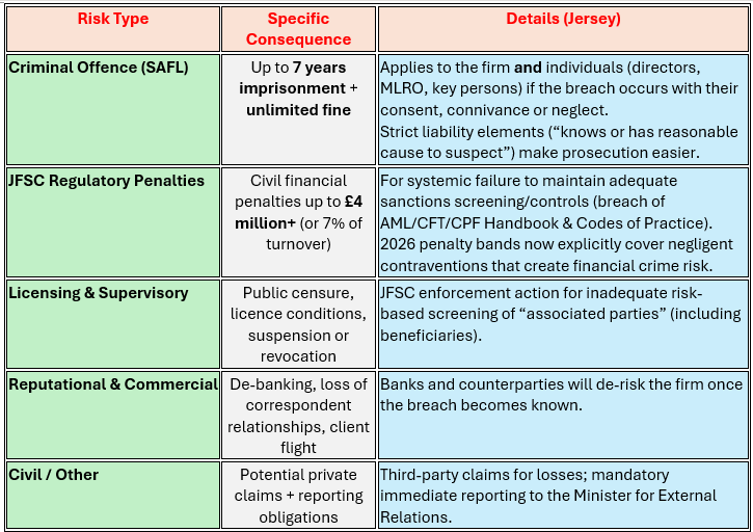
Bottom line:
- Missing the 4th-tier control is not a “technical” compliance gap; it is a real, enforceable sanctions breach the moment the beneficiary becomes a DP.
- The four-tier test (as confirmed by Hellard and Mints) closes exactly these loopholes. Firms that continue to rely solely on the three-tier AML test are exposed to material legal and regulatory risks.
- This is why iTrackAML | AML Compliance & Risk Assessment Software solution screens every beneficiary (vested or discretionary) in real time because the cost of getting it wrong is measured in years in prison, multi-million-pound fines, and destroyed reputations.
Why the Four-Tier Test Is a Strong (But Not the Only) Reason to Screen Beneficiaries
- Sanctions Evasion Prevention The four-tier approach closes loopholes that the three-tier test leaves open. Discretionary beneficiaries are classic vehicles for latent control or indirect benefit.
- Screening prevents prohibited payments, asset freezes or facilitation of circumvention.
- JFSC Explicit Expectations JFSC sanctions guidance and the AML/CFT/CPF Handbook (updated 1 July 2023 and further 31 May 2026) require risk-based screening of customers, beneficial owners, controllers and other associated parties (including trustees, settlors, protectors and beneficiaries). This goes beyond the three-tier BO test.
- Adverse Media and PEP Risks. Even non-sanctioned beneficiaries can introduce reputational, corruption or proliferation-financing (CPF) risks. PEP screening identifies elevated political exposure; adverse media flags negative news that could indicate higher ML/TF/PF risk.
- Ongoing Monitoring and Enforcement Reality Trigger events, periodic reviews and transaction monitoring must capture changes in beneficiary status or new designations. Relying solely on the three-tier test exposes firms to JFSC findings, civil/criminal liability and de-risking by correspondent banks.
Practical Takeaway for Jersey Firms
- iTrackAML's AML compliance and risk assessment software, including sanctions and screening solutions, is designed for this challenge. It screens all beneficiaries (vested or discretionary) against sanctions lists, PEPs, EPs, and adverse media in real time, with ongoing automated monitoring.
- Firms that continue to limit screening to “vetted interests” under the three-tier test alone are operating with yesterday’s compliance standard.
- In short, the four-tier sanctions test revealed in recent UK case law (and highlighted in Comsure updates) is a compelling, standalone reason to screen beneficiaries comprehensively. Combined with JFSC guidance, risk-based obligations and the need to manage adverse media/PEP exposure, there is simply no defensible basis for leaving any beneficiary unscreened.
CLOSE
- Mat Comsure Group
- Stay compliant,
- Any questions:- mathew@comsuregroup.com www.comsuregroup.com
Sources
Official JFSC Sources (Core Regulatory References)
- JFSC Beneficial Ownership and Controller Guidance (explains the three-tier test in detail): https://www.jerseyfsc.org/industry/guidance-and-policy/beneficial-ownership-and-controller-guidance/
- JFSC AML/CFT/CPF Handbook Section 4 (full three-tier test for beneficial owners/controllers): https://www.jerseyfsc.org/media/6933/handbook-section-4.pdf
- JFSC AML/CFT/CPF Handbook (full consolidated version, effective 1 September 2023; next major update 31 May 2026): https://www.jerseyfsc.org/industry/financial-crime/amlcftcpf-handbooks/amlcftcpf-handbook/
- JFSC Financial Sanctions Practical Guidance (screening expectations for beneficiaries, trustees, settlors, etc.): https://www.jerseyfsc.org/industry/international-co-operation/sanctions/financial-sanctions-practical-guidance/
- JFSC New Sanctions Compliance Obligations (effective 1 July 2023 screening of associated parties): https://www.jerseyfsc.org/news-and-events/new-sanctions-compliance-obligations-in-effect-from-1-july-2023/
Sanctions and Asset-Freezing (Jersey) Law 2019
- Full legislation: https://www.jerseylaw.je/laws/current/l_2_2019
Key UK Sanctions Case Law (Four-Tier Control Test)
- Hellard & Ors v OJSC Rossiysky Kredit Bank & Ors [2024] EWHC 1783 (Ch) full judgment (introduces the refined taxonomy of control): https://www.rahmanravelli.co.uk/assets/Uploads/2ef5ed6698/Kevin-Hellard-Ors-v-OJSC-Rossiysky-Kredit-Bank-in-liquidation-Ors-v3.pdf
- Morgan Lewis analysis of the Hellard case (clear explanation of the four-tier control test and its implications for sanctions): https://www.morganlewis.com/pubs/2024/07/update-control-for-uk-sanctions-addressed-in-hellard-case
- Wedlake Bell summary of Hellard judgment: https://wedlakebell.com/insights/hellard-v-ojsc-rossiysky-kredit-bank/
Comsure Group Articles (Internal Context / Related Commentary)
- Comsure ASK MAT article on the three-tier test: https://www.comsuregroup.com/news/ask-mat-do-you-think-the-jfsc-should-revisit-and-update-its-three-tier-test-for-beneficial-ownership-and-controllers/
- Comsure update on the upcoming JFSC AML/CFT/CPF Handbook (31 May 2026): http://www.comsuregroup.com/news/updated-jfsc-amlcftcpf-handbook-now-expected-31-may-2026/
The Team
Meet the team of industry experts behind Comsure
Find out moreLatest News
Keep up to date with the very latest news from Comsure
Find out moreGallery
View our latest imagery from our news and work
Find out moreNews Disclaimer
As well as owning and publishing Comsure's copyrighted works, Comsure wishes to use the copyright-protected works of others. To do so, Comsure is applying for exemptions in the UK copyright law. There are certain very specific situations where Comsure is permitted to do so without seeking permission from the owner. These exemptions are in the copyright sections of the Copyright, Designs and Patents Act 1988 (as amended)[www.gov.UK/government/publications/copyright-acts-and-related-laws]. Many situations allow for Comsure to apply for exemptions. These include 1] Non-commercial research and private study, 2] Criticism, review and reporting of current events, 3] the copying of works in any medium as long as the use is to illustrate a point. 4] no posting is for commercial purposes [payment]. (for a full list of exemptions, please read here www.gov.uk/guidance/exceptions-to-copyright]. Concerning the exceptions, Comsure will acknowledge the work of the source author by providing a link to the source material. Comsure claims no ownership of non-Comsure content. The non-Comsure articles posted on the Comsure website are deemed important, relevant, and newsworthy to a Comsure audience (e.g. regulated financial services and professional firms [DNFSBs]). Comsure does not wish to take any credit for the publication, and the publication can be read in full in its original form if you click the articles link that always accompanies the news item. Also, Comsure does not seek any payment for highlighting these important articles. If you want any article removed, Comsure will automatically do so on a reasonable request if you email info@comsuregroup.com.
Archived News
To find our older articles, please click here.
View archive

To find our older articles, please click here.