
Black Swan vs Grey Rhino: Navigating Unpredictable and Ignored Risks in Modern Risk Management
16/03/2026
In the world of risk management, two animal metaphors have become essential shorthand for understanding high-impact events:
- The Black Swan and
- The Grey Rhino.
These concepts have been popularised by thinkers like
- Nassim Nicholas Taleb (for Black Swans) and
- Michele Wucker (for Grey Rhinos),
These concepts help organisations differentiate between the truly unforeseeable and the dangerously overlooked.
But why does this matter?
- In processes like Business Risk Assessment (BRA) and Enterprise-Wide Risk Assessment (EWRA), critical tools in sectors like finance, compliance, and anti-money laundering (AML), recognising the difference can mean the distinction between reactive chaos and proactive resilience.
- Below is a breakdown of Black Swans and Grey Rhinos, a comparison of the two, and an exploration of their pivotal role in BRA/EWRA frameworks.
What is a Black Swan Event?
Imagine an event so rare and shocking that it rewrites the rules overnight. That's a Black Swan.
Coined by Nassim Taleb in his 2007 book The Black Swan, this term describes occurrences that are:
- Unforeseeable: There are no reliable indicators or patterns to predict them in advance. They're outliers in every sense.
- High-Impact: When they hit, they cause massive, widespread disruption, think economic meltdowns or global upheavals.
- Subject to Hindsight Bias: After the fact, everyone scrambles to explain why it "should have been obvious," even though it genuinely wasn't predictable with the information available at the time.
Real-World Examples of Black Swans
- Sudden geopolitical shocks, like the unforeseen escalation of a regional conflict into a global crisis.
- Highly novel terrorist attacks that exploit entirely new vulnerabilities.
- Unexpected market collapses driven by hidden, systemic flaws that no one anticipated.
For risk managers,
- Black Swans underscore the limits of prediction.
- You can't forecast them, so the focus shifts to building organisational toughness: diversified strategies, robust scenario planning, and a culture that embraces uncertainty.
- In essence, it's about preparing to absorb shocks rather than trying to spot them on the horizon.
What is a Grey Rhino Event?
On the flip side, a Grey Rhino is the elephant or rather, the rhinoceros in the room: a threat that's staring you right in the face, but you choose to ignore it anyway.
Michele Wucker introduced this term in her 2016 book The Grey Rhino, defining it as:
- Visible and Obvious: Warning signs are abundant and have been flashing for ages.
- Highly Probable: Unlike Black Swans, these aren't rare; they're likely to happen if left unaddressed.
- Dangerous: They pack a punch, potentially leading to severe operational, financial, or reputational damage.
- Neglected: Despite the clarity, organisations often delay action due to bureaucratic inertia, denial, or the sheer complexity of tackling them.
Elephant Or Rhinoceros In The Room
Michele Wucker explained the distinction, Elephant or Rhinoceros in the Room, in interviews:
- The elephant in the room assumes "saying and doing nothing is normal."
- The Grey Rhino counters that by saying, "No, it's not normal, you do have a choice. It's not inevitable that I'll trample you."
In risk management (like in BRA/EWRA processes), this matters a lot: Grey Rhinos highlight "failure to act" on foreseeable threats, which regulators often penalise, whereas the elephant metaphor doesn't push as hard for accountability or mitigation planning.
Bottom Line
- The elephant in the room is about passive, resigned awareness of an obvious issue.
- The Grey Rhino is about active denial of a charging, probable catastrophe; it's the same "obviousness," but with urgency, momentum, and a call to do something about it
- The Grey Rhino is intentionally more energising and actionable, especially useful when you want to move beyond just acknowledging a problem to actually preventing or surviving it.
Real-World Examples of Grey Rhinos
- Climate-related risks, such as rising sea levels or extreme weather patterns, have been documented for decades.
- Cybersecurity vulnerabilities, like outdated systems that hackers could exploit at any time.
- Chronic weaknesses in AML/CFT (Anti-Money Laundering/Countering the Financing of Terrorism) frameworks that management knows about but hasn't fixed.
- Unsustainable economic bubbles, like housing or credit markets, that show clear signs of overheating.
Grey Rhinos aren't about surprise; they're about accountability.
- Risk management here demands proactive steps: early intervention, strong governance structures, and holding leaders responsible for inaction.
- Regulators, in particular, view Grey Rhino failures as preventable lapses, which often lead to hefty fines or heightened scrutiny.
Black Swan vs Grey Rhino: A Side-by-Side Comparison
To truly grasp the distinction, let's put them head-to-head in a simple table:
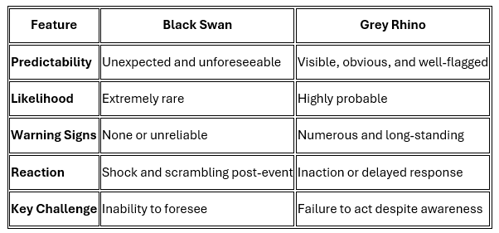
In one succinct sentence: A Black Swan is an unforeseeable shock that blindsides everyone, while a Grey Rhino is a predictable, obvious threat that organisations still fail to charge head-on.
Why This Distinction Matters in BRA/EWRA Processes
Now, let's tie this back to the BRA (Business Risk Assessment) and EWRA (Enterprise-Wide Risk Assessment) processes.
These are foundational in regulated industries, especially finance and compliance, where firms must systematically identify, evaluate, and mitigate risks across operations. BRA focuses on business-specific risks, while EWRA takes a holistic, organisation-wide view, often mandated by frameworks such as AML/CFT regulations.
The Black Swan vs Grey Rhino lens is invaluable here for several reasons:
- Improved Risk Identification: In BRA/EWRA, teams map out potential threats. Black Swans remind us to include "unknown unknowns" through stress testing and horizon scanning, ensuring plans account for extreme scenarios. Grey Rhinos, however, highlight "known knowns" that are often downplayed, prompting a deeper dive into overlooked vulnerabilities, such as persistent compliance gaps or supply chain weaknesses.
- Enhanced Governance and Accountability: Regulators expect firms to prioritise Grey Rhinos in EWRA, as these represent "failure to act" risks. For instance, in AML/CFT assessments, overlooking chronic issues (e.g., inadequate customer due diligence) could be seen as negligence. Black Swans, while harder to govern, push for governance that builds adaptive resilience, such as diversified funding sources or rapid-response protocols.
- Better Preparedness and Mitigation: BRA/EWRA isn't just about listing risks; it's about action. For Grey Rhinos, this means allocating resources to fix obvious problems early, reducing the likelihood of escalation. For Black Swans, it involves creating buffers, such as capital reserves or crisis simulation exercises, to weather the storm. Distinguishing the two prevents wasting effort on over-predicting the unpredictable while ignoring the actionable.
- Regulatory and Strategic Implications: In an era of increasing scrutiny (think Basel III or EU AML directives), regulators are cracking down on Grey Rhino oversights. Firms that integrate this distinction into BRA/EWRA demonstrate maturity and may avoid penalties. Strategically, it fosters a culture of vigilance: Black Swans test your endurance, but Grey Rhinos reveal your leadership flaws.
Ultimately, BRA/EWRA processes thrive when organisations treat Black Swans as calls for humility and flexibility, and Grey Rhinos as urgent wake-up calls. Ignoring the latter can turn a manageable threat into a full-blown crisis, while over-focusing on the former might lead to paranoia without progress.
Final Thoughts: Don't Wait for the Stampede
In risk management, the Black Swan and Grey Rhino aren't just clever analogies; they're practical tools for survival. By understanding their differences, organisations can shift from reactive firefighting to strategic foresight.
Especially in BRA/EWRA, this mindset ensures you're not just assessing risks but truly managing them. So, the next time your team spots a looming Grey Rhino, don't look away, charge forward. And for those elusive Black Swans? Build a nest that's strong enough to withstand the unexpected.
SOURCES
- Here is a list of reliable web sources on the topic of Black Swan vs Grey Rhino (also spelt Grey Rhino) in risk management, including their definitions, differences, examples, and relevance to processes like risk assessment (e.g., in enterprise risk management, compliance, AML/CFT, or BRA/EWRA contexts).
- These are drawn from credible publications, books, articles, and expert discussions.
CORE FOUNDATIONAL SOURCES
- The Grey Rhino: How to Recognise and Act on the Obvious Dangers We Ignore (Book by Michele Wucker, who coined "Grey Rhino")
- https://www.amazon.com/Gray-Rhino-Recognize-Obvious-Dangers/dp/125005382X
- Also: Official site → https://wucker.thegrayrhino.com/writing/the-gray-rhino
- Relevance: Primary source for Grey Rhino concept; contrasts with Black Swan.
- The Black Swan: The Impact of the Highly Improbable (Book by Nassim Nicholas Taleb)
- Wikipedia summary: https://en.wikipedia.org/wiki/The_Black_Swan:_The_Impact_of_the_Highly_Improbable
- Black Swan theory page: https://en.wikipedia.org/wiki/Black_swan_theory
- Relevance: Foundational for Black Swan events.
Comparative Articles & Analyses
- Black Swan, Grey Rhino, White Elephant & Black Jellyfish: Risk Metaphors Explained (The Institute of Risk Management India)
- https://www.theirmindia.org/blog/decoding-the-zoo-of-risks-understanding-black-swan-grey-rhino-white-elephant-and-black-jellyfish-in-risk-management
- Published: July 25, 2023
- Relevance: Clear side-by-side explanation of Black Swan vs Grey Rhino in risk management strategy.
- Do “Grey Rhinos” Pose a Greater Threat Than Black Swans? (CFA Institute)
- https://blogs.cfainstitute.org/investor/2017/10/23/do-gray-rhinos-pose-a-greater-threat-than-black-swans
- Published: October 23, 2017
- Relevance: Interview with Michele Wucker; discusses evolution from Grey Rhinos to Black Swans and implications for investors/risk pros.
- How Black Swans and Grey Rhinos damage unsuspecting businesses (Atradius Group)
- https://group.atradius.com/knowledge-and-research/resources/how-black-swans-and-grey-rhinos-damage-unsuspecting-businesses
- Relevance: Business-focused comparison; ties to proactive risk management and mitigation tools.
- Black swans, grey rhinos, and silver linings: Anticipating geopolitical risks (and openings) (McKinsey & Company)
- https://www.mckinsey.com/capabilities/risk-and-resilience/our-insights/black-swans-gray-rhinos-and-silver-linings-anticipating-geopolitical-risks-and-openings
- Published: February 24, 2023
- Relevance: Framework for scenario planning; applies to corporate/geopolitical risks.
- Is it a Black Swan Event or a Grey Rhino? (The Emergency Management Network)
- https://emnetwork.substack.com/p/is-it-a-black-swan-event-or-a-gray
- Published: December 15, 2025
- Relevance: Discusses mislabelling risks; emphasises action on Grey Rhinos for resilience.
Additional Expert & Industry Perspectives
- Grey Rhinos & Black Swans Define Our Risk Fingerprints (Medium – The Future is Electric)
- https://medium.com/the-future-is-electric/gray-rhinos-black-swans-define-our-risk-fingerprints-fc78de9924b5
- Published: December 3, 2024
- Relevance: Interview with Michele Wucker on personal/organisational risk approaches.
- The Difference between a Black Swan and Grey Rhino (The Grey Rhino official site / The National)
- https://www.thegrayrhino.com/the-national-the-difference-between-a-black-swan-and-grey-rhino
- Published: April 24, 2020
- Relevance: Forward-looking Grey Rhino theory vs hindsight Black Swan.
- Black swans to grey rhinos: Robust decision making for Natech scenarios caused by floods (ScienceDirect – Journal article)
- https://www.sciencedirect.com/science/article/abs/pii/S095042302500213X
- Relevance: Academic view on how ignored risks shift from Black Swan to Grey Rhino; useful for technical risk analysis.
The Team
Meet the team of industry experts behind Comsure
Find out moreLatest News
Keep up to date with the very latest news from Comsure
Find out moreGallery
View our latest imagery from our news and work
Find out moreContact
Think we can help you and your business? Chat to us today
Get In TouchNews Disclaimer
As well as owning and publishing Comsure's copyrighted works, Comsure wishes to use the copyright-protected works of others. To do so, Comsure is applying for exemptions in the UK copyright law. There are certain very specific situations where Comsure is permitted to do so without seeking permission from the owner. These exemptions are in the copyright sections of the Copyright, Designs and Patents Act 1988 (as amended)[www.gov.UK/government/publications/copyright-acts-and-related-laws]. Many situations allow for Comsure to apply for exemptions. These include 1] Non-commercial research and private study, 2] Criticism, review and reporting of current events, 3] the copying of works in any medium as long as the use is to illustrate a point. 4] no posting is for commercial purposes [payment]. (for a full list of exemptions, please read here www.gov.uk/guidance/exceptions-to-copyright]. Concerning the exceptions, Comsure will acknowledge the work of the source author by providing a link to the source material. Comsure claims no ownership of non-Comsure content. The non-Comsure articles posted on the Comsure website are deemed important, relevant, and newsworthy to a Comsure audience (e.g. regulated financial services and professional firms [DNFSBs]). Comsure does not wish to take any credit for the publication, and the publication can be read in full in its original form if you click the articles link that always accompanies the news item. Also, Comsure does not seek any payment for highlighting these important articles. If you want any article removed, Comsure will automatically do so on a reasonable request if you email info@comsuregroup.com.


As well as owning and publishing Comsure's copyrighted works, Comsure wishes to use the copyright-protected works of others. To do so, Comsure is applying for exemptions in the UK copyright law. There are certain very specific situations where Comsure is permitted to do so without seeking permission from the owner. These exemptions are in the copyright sections of the Copyright, Designs and Patents Act 1988 (as amended)[www.gov.UK/government/publications/copyright-acts-and-related-laws]. Many situations allow for Comsure to apply for exemptions. These include 1] Non-commercial research and private study, 2] Criticism, review and reporting of current events, 3] the copying of works in any medium as long as the use is to illustrate a point. 4] no posting is for commercial purposes [payment]. (for a full list of exemptions, please read here www.gov.uk/guidance/exceptions-to-copyright]. Concerning the exceptions, Comsure will acknowledge the work of the source author by providing a link to the source material. Comsure claims no ownership of non-Comsure content. The non-Comsure articles posted on the Comsure website are deemed important, relevant, and newsworthy to a Comsure audience (e.g. regulated financial services and professional firms [DNFSBs]). Comsure does not wish to take any credit for the publication, and the publication can be read in full in its original form if you click the articles link that always accompanies the news item. Also, Comsure does not seek any payment for highlighting these important articles. If you want any article removed, Comsure will automatically do so on a reasonable request if you email info@comsuregroup.com.