
FATF Grey List Update – 13 February 2026 – now there are 22
16/02/2026
Kuwait and Papua New Guinea Added to Jurisdictions Under Increased Monitoring
On 13 February 2026, the Financial Action Task Force (FATF) concluded the first Plenary of the year, held in Mexico City from 11–13 February 2026, and announced a significant update to its list of Jurisdictions under Increased Monitoring (the “Grey List”). The key headline from the session was the addition of Kuwait and Papua New Guinea (PNG) to the Grey List.
This update reflects FATF’s ongoing review cycle, during which it evaluates jurisdictions’ Anti‑Money Laundering, Counter‑Terrorist Financing, and Counter‑Proliferation Financing (AML/CFT/CPF) frameworks.
Countries placed on the Grey List have identified strategic deficiencies but have committed to time-bound action plans to address them under enhanced FATF monitoring.
The February 2026 publications clarified that no jurisdictions were removed from the Grey List during this cycle.
Why Kuwait Was Grey‑Listed
- According to the FATF’s February 2026 update, Kuwait has newly been identified as having strategic deficiencies requiring strengthened AML/CFT/CPF measures.
- The FATF notes that Kuwait is now under increased monitoring and has committed to addressing weaknesses highlighted through the mutual evaluation follow-up processes.
- Independent reporting emphasised that FATF expects Kuwait to enhance implementation of risk-based supervision, improve suspicious transaction reporting effectiveness, and strengthen TF and PF-related controls in line with FATF recommendations.
Why Papua New Guinea Was Grey‑Listed
- Papua New Guinea joins the Grey List after FATF identified persistent AML/CFT/CPF compliance gaps relating to ML/TF risk assessment, beneficial ownership transparency, cross-border reporting, and law enforcement capacity.
- The FATF publication states that PNG has agreed to an action plan and is expected to implement reforms on an expedited timeline.
What Grey‑Listing Means
- Grey-listed jurisdictions are not subject to FATF calls for enhanced due diligence or countermeasures. Instead, they are placed under “increased monitoring”, meaning they must demonstrate measurable progress in implementing FATF recommendations.
Grey‑listing typically results in:
- Higher scrutiny by correspondent banking partners
- Higher risk ratings by financial institutions and DNFBPs
- Increased due diligence on customers linked to the jurisdiction
- Greater engagement between government agencies and FATF-style regional bodies (FSRBs)
- Grey‑listing often triggers internal compliance changes, including EDD thresholds, transaction monitoring calibration, periodic review frequency, and approvals for higher‑risk relationships.
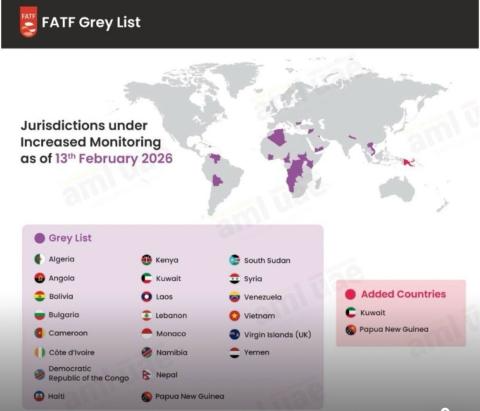
1. FULL UPDATED GREY LIST (as of 13 February 2026)
Based on the FATF’s official publication and independent AML reporting, the Grey List includes the following jurisdictions as of 13 February 2026:
- Algeria
- Angola
- Bolivia
- Bulgaria
- Cameroon
- Côte d’Ivoire
- Democratic Republic of the Congo
- Haiti
- Kenya
- Kuwait (new)
- Lao PDR
- Lebanon
- Monaco
- Namibia
- Nepal
- Papua New Guinea (new)
- South Sudan
- Syria
- Venezuela
- Vietnam
- Virgin Islands (UK)
- Yemen
2. EXPECTATIONS FATF HAS SET FOR KUWAIT AND PNG
A. Kuwait’s Expected Action Plan Components
- Enhance risk-based supervision of financial institutions and DNFBPs
- Strengthen TF and PF investigative capacity
- Improve suspicious transaction reporting frameworks
- Increase beneficial ownership transparency
- Implement more robust targeted financial sanctions procedures
- Improve cross-agency coordination for ML/TF prosecutions
These expectations align with common deficiencies identified in prior evaluations.
B. Papua New Guinea’s Expected Action Plan Components
- Conduct improved ML/TF national risk assessments
- Strengthen cross-border currency reporting and enforcement
- Enhance the effectiveness of FIU operations
- Improve investigation and prosecution capabilities
- Increase beneficial ownership transparency
- Ensure supervisory authorities adopt risk-based AML/CFT supervision
Both jurisdictions must report progress regularly and host on-site assessments once milestones are met.
3. IMPLICATIONS FOR RISK ASSESSMENTS, EDD & POLICY UPDATES
A. Risk Assessments
Regulated entities should:
- Update jurisdictional risk ratings for Kuwait and PNG
- Integrate updated FATF publications into enterprise-wide ML/TF/PF risk assessments
- Reassess geographic and cross-border exposure risks
- Consider knock-on effects on connected business sectors
B. Enhanced Due Diligence (EDD)
EDD expectations typically include:
- Strengthened customer due diligence (CDD) for individuals and entities with ties to Kuwait or PNG
- Enhanced source of wealth/source of funds verification
- Escalated senior management approvals for establishing or maintaining relationships
- Higher alert thresholds for transaction monitoring
C. Ongoing Monitoring
Expected enhancements:
- More frequent periodic reviews for customers linked to grey-listed jurisdictions
- Additional monitoring for cross-border transactions
- Screening for involvement in high-risk sectors (e.g., MSBs, real estate)
D. Internal Controls & Governance
This includes:
- Updating AML/CFT policies and procedures
- Incorporating new jurisdictional risks into training programmes
- Reviewing correspondent banking arrangements linked to the newly grey-listed countries
SUMMARY
- Kuwait and Papua New Guinea were officially added to the FATF Grey List on 13 February 2026.
- No jurisdictions were removed.
- Both jurisdictions now operate under FATF-mandated action plans to remediate AML/CFT/CPF deficiencies.
- Compliance teams worldwide should immediately update risk assessments, EDD protocols, transaction monitoring models, and jurisdictional risk matrices.
List of Web Sources
1. Jurisdictions under Increased Monitoring - 13 February 2026
2. Kuwait and Papua New Guinea Added to FATF Grey List
3. FATF February 2026: Kuwait and Papua New Guinea Added to Grey List
Cyprus Gaming & Casino Supervision Commission
4. Country Updates from the FATF Plenary on 13 February 2026
StudyAML
URL: https://studyaml.com/country-updates-from-the-fatf-plenary-on-13-february-2026/
5. February 2026 FATF update: Kuwait and Papua New Guinea added to the increased monitoring list
AML Singapore
6. LATEST: FATF adds Kuwait and Papua New Guinea to AML Grey List
The Team
Meet the team of industry experts behind Comsure
Find out moreLatest News
Keep up to date with the very latest news from Comsure
Find out moreGallery
View our latest imagery from our news and work
Find out moreContact
Think we can help you and your business? Chat to us today
Get In TouchNews Disclaimer
As well as owning and publishing Comsure's copyrighted works, Comsure wishes to use the copyright-protected works of others. To do so, Comsure is applying for exemptions in the UK copyright law. There are certain very specific situations where Comsure is permitted to do so without seeking permission from the owner. These exemptions are in the copyright sections of the Copyright, Designs and Patents Act 1988 (as amended)[www.gov.UK/government/publications/copyright-acts-and-related-laws]. Many situations allow for Comsure to apply for exemptions. These include 1] Non-commercial research and private study, 2] Criticism, review and reporting of current events, 3] the copying of works in any medium as long as the use is to illustrate a point. 4] no posting is for commercial purposes [payment]. (for a full list of exemptions, please read here www.gov.uk/guidance/exceptions-to-copyright]. Concerning the exceptions, Comsure will acknowledge the work of the source author by providing a link to the source material. Comsure claims no ownership of non-Comsure content. The non-Comsure articles posted on the Comsure website are deemed important, relevant, and newsworthy to a Comsure audience (e.g. regulated financial services and professional firms [DNFSBs]). Comsure does not wish to take any credit for the publication, and the publication can be read in full in its original form if you click the articles link that always accompanies the news item. Also, Comsure does not seek any payment for highlighting these important articles. If you want any article removed, Comsure will automatically do so on a reasonable request if you email info@comsuregroup.com.


As well as owning and publishing Comsure's copyrighted works, Comsure wishes to use the copyright-protected works of others. To do so, Comsure is applying for exemptions in the UK copyright law. There are certain very specific situations where Comsure is permitted to do so without seeking permission from the owner. These exemptions are in the copyright sections of the Copyright, Designs and Patents Act 1988 (as amended)[www.gov.UK/government/publications/copyright-acts-and-related-laws]. Many situations allow for Comsure to apply for exemptions. These include 1] Non-commercial research and private study, 2] Criticism, review and reporting of current events, 3] the copying of works in any medium as long as the use is to illustrate a point. 4] no posting is for commercial purposes [payment]. (for a full list of exemptions, please read here www.gov.uk/guidance/exceptions-to-copyright]. Concerning the exceptions, Comsure will acknowledge the work of the source author by providing a link to the source material. Comsure claims no ownership of non-Comsure content. The non-Comsure articles posted on the Comsure website are deemed important, relevant, and newsworthy to a Comsure audience (e.g. regulated financial services and professional firms [DNFSBs]). Comsure does not wish to take any credit for the publication, and the publication can be read in full in its original form if you click the articles link that always accompanies the news item. Also, Comsure does not seek any payment for highlighting these important articles. If you want any article removed, Comsure will automatically do so on a reasonable request if you email info@comsuregroup.com.