

Jersey Court Delivers Major CRS Shock: TCSP Directors Trigger Reporting Duty
16/06/2026
The UK government's decision to proscribe Palestine Action as a TERRORIST ORGANISATION has been upheld as lawful by the Court of Appeal.
- In a significant ruling on Monday 15 June 2026, five senior judges overturned a February High Court decision, finding the ban "justified and proportionate".
- The judgment provides important legal certainty for compliance professionals across the British Isles — including in Jersey, where the organisation is treated as proscribed under local terrorism legislation.
The UK Ruling in Detail
- The Court of Appeal, led by Lady Chief Justice Baroness Carr, concluded that the Home Secretary had been legally entitled to proscribe the group. The judges emphasised that Palestine Action
- Overtly promotes unlawful violence amounting to terrorism and
- Operates as "a covert organisation which operates with secret cells to avoid the detection and prosecution of those using violence to destroy property and cause injury."
- The court rejected comparisons to historical civil disobedience groups such as the suffragettes, noting that Palestine Action had neither disowned nor condemned incidents before the ban that ministers assessed as terrorism. These included attacks targeting defence firms involved in UK national security and support for Ukraine.
- The proscription — in force since July 2025 — makes it a criminal offence to
- Belong to, or invite support for, Palestine Action,
- Punishable by up to 14 years' imprisonment in the UK.
- Thousands of arrests have already occurred at demonstrations since the ban took effect.
- Following Monday's ruling, the Metropolitan Police reported 117 arrests on suspicion of supporting a proscribed organisation outside the Royal Courts of Justice, with two further arrests by City of London Police.
- What on earth is her ladyship wearing? The sartorial shambles of Britain's formal garb | The Independent
Baroness Carr said Palestine Action "overtly promotes unlawful violence amounting to terrorism". (Image: PA Media)
- Home Secretary Shabana Mahmood welcomed the decision, stating it "does not affect lawful protest in support of the Palestinian cause".
- She emphasised that Palestine Action's actions "are not consistent with democratic values and the rule of law".
- Group co-founder Huda Ammori indicated an intention to seek permission to appeal to the UK Supreme Court. However, success is uncertain given the detailed five-judge Court of Appeal judgment.
Direct Relevance to Jersey
- Jersey's Terrorism (Jersey) Law 2002 aligns closely with the UK regime.
- Under Article 6(1)(c), an organisation proscribed under section 3 of the UK Terrorism Act 2000 is automatically proscribed in Jersey.
- Jersey compliance officers must be aware that this process is different to sanction updates
- See Appendix 1 for a clear Explanation: Terrorism Proscription vs Sanctions in Jersey
- The Jersey Financial Services Commission (JFSC) confirms that Schedule 1 to the Terrorism (Jersey) Law
- "Follows the UK List of proscribed international terrorist groups" and
- Is amended to reflect changes.
Palestine Action is therefore a proscribed organisation under Jersey law.
- Membership or support offences carry a maximum penalty of up to 10 years' imprisonment in Jersey.
- Regulated financial services businesses must maintain robust systems and controls to prevent and detect terrorist financing, including screening against proscribed organisations.
Action Points for Jersey Compliance Officers
- Update screening lists immediately —
- Ensure customer due diligence (CDD), enhanced due diligence (EDD), and ongoing monitoring systems explicitly include "Palestine Action" and known aliases.
- This applies to onboarding, periodic reviews, and transaction monitoring.
- Review policies and training —
- Update financial crime policies, risk assessments, and staff training to cover the specific risks posed by support for proscribed organisations (including expressions of support that may cross into material or financial assistance).
- Emphasise that lawful, peaceful advocacy for the Palestinian cause remains unaffected.
- Heighten vigilance on red flags — Watch for:
- Donations, crowdfunding, or payment flows linked to direct-action or protest groups.
- Beneficial owners or controllers with known affiliations to proscribed entities.
- Corporate vehicles or structures that could obscure support for unlawful activity.
- Suspicious Activity Reporting (SAR) —
- Any knowledge or suspicion of dealings with or support for Palestine Action should be considered for a SAR to the Jersey Financial Intelligence Unit (JFIU), in line with obligations under the Terrorism (Jersey) Law 2002 and the Proceeds of Crime (Jersey) Law 1999 (as amended).
Monitor developments —
- While the Court of Appeal ruling provides strong legal certainty, any successful appeal to the UK Supreme Court (or future deproscription application) could change the position. Maintain horizon scanning via JFSC alerts, Jersey Law, and UK Home Office updates.
- The Court of Appeal's emphasis on the Home Secretary's wide margin of discretion in national security matters is likely to influence how similar challenges are viewed in other jurisdictions that align with UK counter-terrorism frameworks.
Jersey's finance industry has a strong reputation for robust financial crime controls.
- This ruling reinforces the need for continued vigilance and proactive compliance to protect both the Island's reputation and its institutions from the risks associated with terrorist financing and support for proscribed organisations.
Appendix
Appendix 1
Clear Explanation: Proscription vs Sanctions in Jersey
Here is a precise breakdown of how the two regimes work and where they differ.
- Proscription under the Terrorism (Jersey) Law 2002
Mechanism (Article 6)
Article 6(1) of the Terrorism (Jersey) Law 2002 states:
"For this Law an organisation is proscribed if— (a) it is listed in Schedule 1; (b) it operates under the same name as an organisation listed in that Schedule; or (c) it is proscribed by virtue of or under section 3 of the Terrorism Act 2000 of the United Kingdom Parliament."
This is a definitional incorporation. When the UK Home Secretary adds an organisation (such as Palestine Action) to the UK proscribed list under the Terrorism Act 2000, that organisation automatically becomes proscribed in Jersey for Jersey criminal law. No separate Jersey Order or regulation is required to trigger the criminal offences (membership, inviting support, etc.).
The Minister can still make an Order under Article 6(3) to add the organisation to Schedule 1 (for transparency and to keep the published list current), but this is not legally necessary for the offences to apply. The automatic effect comes from Article 6(1)(c).
- Financial Sanctions under the Sanctions and Asset-Freezing (Jersey) Law 2019 (SAFL)
Jersey does not maintain its own standalone list of sanctioned persons. Instead:
- SAFL (as amended, including the important Sanctions and Asset-Freezing (Automatic Implementation of UK Sanctions) (Jersey) Amendment Order 2025) contains ambulatory provisions.
- These provisions state that UK sanctions designations (asset freezes, prohibitions on making funds or economic resources available, etc.) made under the UK's Sanctions and Anti-Money Laundering Act 2018 have immediate and automatic effect in Jersey.
- When the UK (OFSI) adds or removes a name from the UK Consolidated List, the corresponding obligations in Jersey update automatically — usually with immediate effect.
In practice, compliance systems in Jersey pull the live UK sanctions list (often via the JFSC or commercial screening providers), and the legal obligations change in real time as the UK list does.
Key Differences
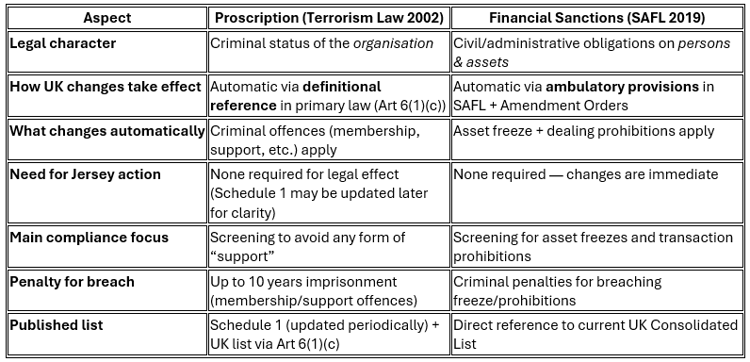
Practical Implications for Jersey Compliance Officers
- Proscription gives immediate criminal effect the moment the UK Home Secretary signs the proscription order. You do not have to wait for a Jersey Order.
- Sanctions also give immediate effect, but they are more granular (specific named individuals and entities rather than whole organisations) and are primarily about freezing assets and stopping transactions.
- In both cases Jersey has deliberately chosen mechanisms that avoid the need for a new piece of Jersey legislation every time the UK acts. This is why both regimes are described as "aligning closely" with the UK.
- The small practical difference is that published Schedule 1 of the Terrorism Law is sometimes updated with a short lag (hence JFSC's wording "has been amended to reflect changes"). In contrast, the ambulatory sanctions mechanism is designed to be as close to real-time as possible.
Bottom line:
Both systems are largely automatic, but they achieve this through slightly different legislative techniques because they serve different purposes — one concerns the criminal status of organisations, the other imposes immediate financial restrictions on designated persons.
End
For the latest JFSC guidance on sanctions and proscribed organisations screening, visit the JFSC website or contact your usual compliance adviser. This article is for informational purposes and does not constitute legal advice.
Source
The Team
Meet the team of industry experts behind Comsure
Find out moreLatest News
Keep up to date with the very latest news from Comsure
Find out moreGallery
View our latest imagery from our news and work
Find out moreContact
Think we can help you and your business? Chat to us today
Get In TouchNews Disclaimer
As well as owning and publishing Comsure's copyrighted works, Comsure wishes to use the copyright-protected works of others. To do so, Comsure is applying for exemptions in the UK copyright law. There are certain very specific situations where Comsure is permitted to do so without seeking permission from the owner. These exemptions are in the copyright sections of the Copyright, Designs and Patents Act 1988 (as amended)[www.gov.UK/government/publications/copyright-acts-and-related-laws]. Many situations allow for Comsure to apply for exemptions. These include 1] Non-commercial research and private study, 2] Criticism, review and reporting of current events, 3] the copying of works in any medium as long as the use is to illustrate a point. 4] no posting is for commercial purposes [payment]. (for a full list of exemptions, please read here www.gov.uk/guidance/exceptions-to-copyright]. Concerning the exceptions, Comsure will acknowledge the work of the source author by providing a link to the source material. Comsure claims no ownership of non-Comsure content. The non-Comsure articles posted on the Comsure website are deemed important, relevant, and newsworthy to a Comsure audience (e.g. regulated financial services and professional firms [DNFSBs]). Comsure does not wish to take any credit for the publication, and the publication can be read in full in its original form if you click the articles link that always accompanies the news item. Also, Comsure does not seek any payment for highlighting these important articles. If you want any article removed, Comsure will automatically do so on a reasonable request if you email info@comsuregroup.com.


As well as owning and publishing Comsure's copyrighted works, Comsure wishes to use the copyright-protected works of others. To do so, Comsure is applying for exemptions in the UK copyright law. There are certain very specific situations where Comsure is permitted to do so without seeking permission from the owner. These exemptions are in the copyright sections of the Copyright, Designs and Patents Act 1988 (as amended)[www.gov.UK/government/publications/copyright-acts-and-related-laws]. Many situations allow for Comsure to apply for exemptions. These include 1] Non-commercial research and private study, 2] Criticism, review and reporting of current events, 3] the copying of works in any medium as long as the use is to illustrate a point. 4] no posting is for commercial purposes [payment]. (for a full list of exemptions, please read here www.gov.uk/guidance/exceptions-to-copyright]. Concerning the exceptions, Comsure will acknowledge the work of the source author by providing a link to the source material. Comsure claims no ownership of non-Comsure content. The non-Comsure articles posted on the Comsure website are deemed important, relevant, and newsworthy to a Comsure audience (e.g. regulated financial services and professional firms [DNFSBs]). Comsure does not wish to take any credit for the publication, and the publication can be read in full in its original form if you click the articles link that always accompanies the news item. Also, Comsure does not seek any payment for highlighting these important articles. If you want any article removed, Comsure will automatically do so on a reasonable request if you email info@comsuregroup.com.