
Jersey - Kuwait grey list Risk Update — February 2026 – TCB sector exposed 2.2%
17/02/2026
According to the JFSC Aggregated Sector Data 2020–2024,
- Only the TCB sector has meaningful exposure to Kuwait – the JFSC statistics showed 998 customers (2.2%) in 2024.
- Furthermore, the risk exposure was not considered high.
As of 13 February 2026, the Financial Action Task Force (FATF) has placed Kuwait on its Grey List (“Jurisdictions under Increased Monitoring”).
- This development materially changes Kuwait’s risk profile for Jersey-regulated businesses.
- Kuwait must now be treated as a higher-risk jurisdiction for AML/CFT/CPF purposes, and
- The Articles 17 and 18 exemptions under the Money Laundering (Jersey) Order 2008 are no longer appropriate for Kuwait-connected customers. Immediate updates to customer-level and business-wide risk assessments are required. AND
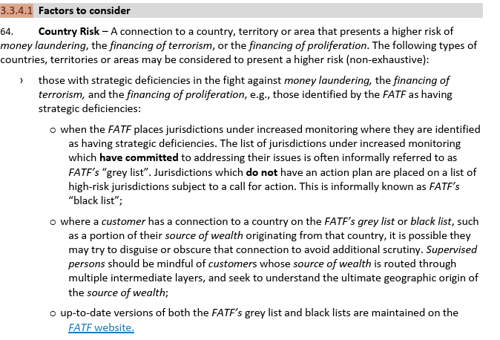
- The obliged person under Article 16 must be reviewed because the JFSC SAYS that HIGHER RISK countries include those countries that meet the following test:-
- When the FATF places jurisdictions under increased monitoring, they are identified as having strategic deficiencies. The list of jurisdictions under increased monitoring which have committed to addressing their issues is often informally referred to as FATF’s “grey list”. Jurisdictions that do not have an action plan are added to a high-risk list and subject to a call for action. This is informally known as FATF’s “blacklist”;
- Where a customer has a connection to a country on the FATF’s grey list or blacklist, such as a portion of their source of wealth originating from that country, it is possible they may try to disguise or obscure that connection to avoid additional scrutiny. Supervised persons should be mindful of customers whose wealth is routed through multiple intermediaries and seek to understand the ultimate geographic origin of that wealth.
Historic Risk Exposure (Based on JFSC Aggregated Sector Data 2020–2024)
Trust Company Business (TCB) — Kuwait is a Material Customer Jurisdiction
- Kuwait appears in the Top 10 customer/beneficial owner jurisdictions: = 998 customers (2.2%) in 2024.
- Kuwait was NOT identified as:
- A higher‑risk ML jurisdiction
- A higher‑risk TF jurisdiction
- A significant PEP source
Funds Sector (CIF/JPF) — No Kuwait Exposure
- Kuwait does not appear in any top investor lists nor in higher‑risk ML/TF categories. https://www.jerseyfsc.org/media/2dulg0lm/supervisory-risk-data-funds-sector-report-2024.pdf
Banking Sector — No Kuwait Exposure
- Kuwait does not appear in deposits/lending top jurisdictions or ML/TF higher‑risk categories. https://www.jerseyfsc.org/media/jbamiapf/supervisory-risk-data-banking-sector-report-2024.pdf
FATF GREY LISTING — 13–14 FEBRUARY 2026
FATF has officially added Kuwait to the Grey List, along with Papua New Guinea.
Reasons FATF cites for grey‑listing Kuwait:
- Strategic deficiencies in AML/CFT/CPF controls
- Need for strengthening:
- Risk-based supervision
- Suspicious Transaction Reporting (STR) effectiveness
- TF controls
- PF controls
- Requirement to implement time-bound action plans with FATF & MENAFATF [comsuregroup.com]
FATF classification impact:
- Kuwait is now a jurisdiction under increased monitoring.
- FATF does not mandate de-risking but expects enhanced risk-based analysis. [fatf-gafi.org]
IMMEDIATE IMPLICATIONS FOR JERSEY-REGULATED FIRMS
Articles 17 and 18 No Longer Applicable
Given Kuwait’s grey‑listing:
- Article 17 (Exemptions to 3rd-party identification)
- Article 18 (CDD exemptions for specified low-risk categories)
- ➡ Cannot be applied to Kuwait-connected customers, structures, or transactions.
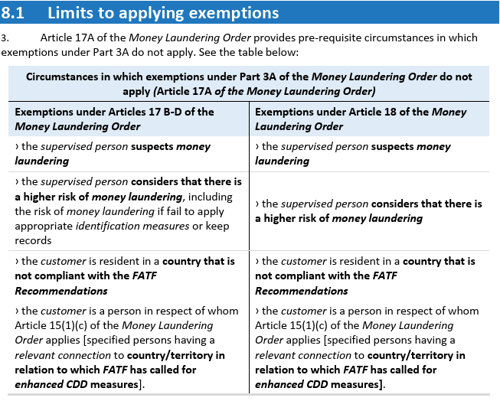
Any previous reliance on:
- Article 17B–D
- Article 18 exemptions must now be withdrawn.(These exemptions were explicitly intended for lower-risk jurisdictions.)
Action:
- Update all onboarding & CDD procedures to prohibit Article 17/18 use for Kuwait.
WHAT ABOUT ARTICLE 16 & OBLIGED PERSONS
The JFSC says Immediately before relying upon an obliged person, a supervised person may demonstrate that it has had regard for the higher risk of money laundering, the financing of terrorism, or the financing of proliferation, and risk that an obliged person will fail to provide the supervised person with evidence of identity without delay if requested to do so, where it considers the following factors:
- The risks posed by the country/territory/area in which the obliged person is based.
- Factors to consider include those found at section 3.3.4.1 of the JFSC Handbook; the adequacy of the framework to combat money laundering, the financing of terrorism, or the financing of proliferation in place in the country/territory/area in which the obliged person is based, and the period of time that the framework has been in place.
Required AML/CFT Actions for the Business
Update the Business Risk Assessment (BRA) & Customer Risk Assessment (CRA)
- Reclassify Kuwait as a Higher-Risk Jurisdiction (ML/TF/PF).
- Update risk matrices, scoring models, and country lists.
Apply Enhanced Due Diligence (EDD) to all Kuwait-related relationships
EDD must include:
- Detailed Source of Funds (SOF) and Source of Wealth (SOW)
- Verification of business activities
- Identification of all beneficial owners
- Adverse media deep screening
- Senior management approval
- Ongoing monitoring at increased frequency
Review All Existing Kuwait Clients
- Re-paper onboarding files
- Reassess risk ratings
- Revisit CDD/EDD completeness
- Validate PEP status (formal and informal influence)
Review TCB exposure immediately.
Given that TCB is the only sector with material Kuwait exposure (2.2%):
- Prioritise targeted TCB portfolio review
- Pay particular attention to:
- Family offices
- Multi-layered holding structures
- Real‑estate-backed wealth
- Cross-border arrangements involving the UAE, Bahrain or Saudi Arabia
Recommended Board-Level Next Steps
- Approve the updated Country Risk Assessment (CRA), including Kuwait as a Higher‑Risk.
- Mandate enhanced EDD policy changes across TCB, Funds, and Banking.
- Direct compliance to conduct a full Kuwait portfolio review within 30–60 days.
- Require testing of monitoring thresholds for Kuwait-linked transactions.
- Ensure exclusion of Kuwait from Articles 17 & 18 exemptions in all policies, procedures, manuals, and automated systems.
- Ensure the obliged persons [under Article 16] exposed to Kuwait are reviewed to ensure the firm's risk appetite and risk-based approach is maintained
- Set oversight reporting for Kuwait exposure and EDD completion rates.
- High-Level Board Statement (Suggested Wording)
- “Following Kuwait’s addition to the FATF Grey List on 13 February 2026, the Board classifies Kuwait as a Higher‑Risk Jurisdiction for AML/CFT/CPF purposes.
- Articles 17 and 18 of the Money Laundering (Jersey) Order 2008 must not be applied to Kuwait-linked customers or transactions.
- Obliged person under Article 16 must be evaluated to ensure the firm's risk appetite and risk-based approach is maintained
- The Board instructs management to update all risk assessments, policies, monitoring frameworks and to conduct a full EDD refresh across all Kuwait-connected relationships.”
Source
The Team
Meet the team of industry experts behind Comsure
Find out moreLatest News
Keep up to date with the very latest news from Comsure
Find out moreGallery
View our latest imagery from our news and work
Find out moreContact
Think we can help you and your business? Chat to us today
Get In TouchNews Disclaimer
As well as owning and publishing Comsure's copyrighted works, Comsure wishes to use the copyright-protected works of others. To do so, Comsure is applying for exemptions in the UK copyright law. There are certain very specific situations where Comsure is permitted to do so without seeking permission from the owner. These exemptions are in the copyright sections of the Copyright, Designs and Patents Act 1988 (as amended)[www.gov.UK/government/publications/copyright-acts-and-related-laws]. Many situations allow for Comsure to apply for exemptions. These include 1] Non-commercial research and private study, 2] Criticism, review and reporting of current events, 3] the copying of works in any medium as long as the use is to illustrate a point. 4] no posting is for commercial purposes [payment]. (for a full list of exemptions, please read here www.gov.uk/guidance/exceptions-to-copyright]. Concerning the exceptions, Comsure will acknowledge the work of the source author by providing a link to the source material. Comsure claims no ownership of non-Comsure content. The non-Comsure articles posted on the Comsure website are deemed important, relevant, and newsworthy to a Comsure audience (e.g. regulated financial services and professional firms [DNFSBs]). Comsure does not wish to take any credit for the publication, and the publication can be read in full in its original form if you click the articles link that always accompanies the news item. Also, Comsure does not seek any payment for highlighting these important articles. If you want any article removed, Comsure will automatically do so on a reasonable request if you email info@comsuregroup.com.


As well as owning and publishing Comsure's copyrighted works, Comsure wishes to use the copyright-protected works of others. To do so, Comsure is applying for exemptions in the UK copyright law. There are certain very specific situations where Comsure is permitted to do so without seeking permission from the owner. These exemptions are in the copyright sections of the Copyright, Designs and Patents Act 1988 (as amended)[www.gov.UK/government/publications/copyright-acts-and-related-laws]. Many situations allow for Comsure to apply for exemptions. These include 1] Non-commercial research and private study, 2] Criticism, review and reporting of current events, 3] the copying of works in any medium as long as the use is to illustrate a point. 4] no posting is for commercial purposes [payment]. (for a full list of exemptions, please read here www.gov.uk/guidance/exceptions-to-copyright]. Concerning the exceptions, Comsure will acknowledge the work of the source author by providing a link to the source material. Comsure claims no ownership of non-Comsure content. The non-Comsure articles posted on the Comsure website are deemed important, relevant, and newsworthy to a Comsure audience (e.g. regulated financial services and professional firms [DNFSBs]). Comsure does not wish to take any credit for the publication, and the publication can be read in full in its original form if you click the articles link that always accompanies the news item. Also, Comsure does not seek any payment for highlighting these important articles. If you want any article removed, Comsure will automatically do so on a reasonable request if you email info@comsuregroup.com.