

Jersey NEDs and de-registration opportunities according to JFSC's Revised Guideline
17/02/2026
The JFSC's revised Article 36 of the Proceeds of Crime (Jersey) Law 1999 (POCL) guidelines represent a positive step toward a more practical, risk-based AML/CFT/CPF regime in Jersey.
By introducing a three-gateway framework (described below), they address long-standing ambiguities and empower NEDs, especially those in philanthropic roles (and who were not sure and registered), to reassess and, if necessary, de-register. For example,
- Mr B is a director of Y Ltd, a company set up by a friend. Mr B has been appointed to provide support and guidance to the company, given his prior experience in the relevant industry.
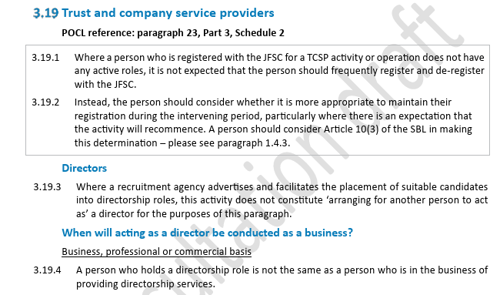
- Mr B holds no other directorships, is paid a nominal rate in recognition of this contribution to the company, but does not hold himself out as providing directorship services to the public.
- This is also a personal arrangement, and Mr B is simply helping a friend.
The updated JFSC guidance now says
- Mr B is unlikely to be assessed as providing the directorship services on a business, professional or commercial basis.
As 30 April 2026 approaches, it's important to evaluate now to avoid unnecessary burdens and maintain the island's reputation for financial integrity.
Introduction
- In the evolving landscape of Jersey's financial regulations, the Jersey Financial Services Commission (JFSC) has proposed significant updates to its guidelines on the interpretation of Article 36 of the Proceeds of Crime (Jersey) Law 1999 (POCL).
- These revisions, set to take effect on 30 April 2026, introduce a structured three-gateway framework designed to clarify whether individuals or entities are carrying on a "financial services business" under Schedule 2 of POCL.
- This is particularly relevant for Non-Executive Directors (NEDs) in Jersey, many of whom have historically registered under the regime even when their roles were philanthropic or unremunerated.
- The new guidance aims to address ambiguities, enhance consistency, and align with the Financial Action Task Force (FATF) international standards.
- For certain NEDs, this could mean an opportunity to de-register, provided they fall outside the scope.
ANALYSIS
- This blog explores the background, the key features of the revised guidelines, and the practical implications for NEDs.
- Whether you're a director assessing your status or simply interested in Jersey's AML/CFT/CPF (Anti-Money Laundering/Countering the Financing of Terrorism/Countering Proliferation Financing) regime, understanding these changes is crucial.
Background on NED Registration Under POCL Schedule 2
- Historically, several NEDs in Jersey found themselves registering under Schedule 2 of POCL simply because they served as directors of one or more companies.
- This often occurred even when their involvement was not for compensation but for philanthropic, personal, or community reasons, such as serving on charity boards or assisting friends in family businesses.
- The previous guidance created uncertainties, leading to cautious over-registration to avoid potential non-compliance risks.
- The JFSC's revisions respond directly to industry feedback and highlight these ambiguities.
- By shifting focus from labels and forms to the substance of activities, the guidelines aim to provide clearer criteria.
- This not only promotes better alignment with FATF standards but also reduces unnecessary regulatory burdens, allowing individuals to reassess their status with greater certainty.
The Structured Three-Gateway Framework
- At the heart of the revised guidelines is a three-gateway framework that serves as a step-by-step test to determine whether an activity constitutes a "financial services business" under Schedule 2 of POCL.
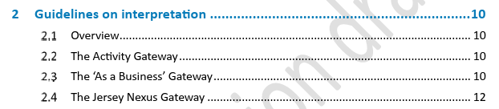
- All three gateways must be satisfied for the regime to apply, triggering the need to register under the Proceeds of Crime (Supervisory Bodies) (Jersey) Law 2008 (SBL) and to comply with Jersey's AML/CFT/CPF requirements.
1. The Activity Gateway
- This gateway examines whether the person's activities or operations fall within Parts 1-4 of Schedule 2.
- These parts cover a range of financial services, including lending, investment management, trust and company services, and virtual asset activities.
- Importantly, the assessment is based on what is done in practice, not on titles or structures.
- For NEDs, acting as a director (including non-executive roles) typically falls under paragraph 23(2) of Part 3, which relates to providing director or partner services.
2. The 'As a Business' Gateway
Here, the activity:
- Must be conducted on a business, professional, or commercial basis, and
- There must be the presence of a customer.
Both elements are required (with exceptions for non-professional trustees).
- Business, Professional, or Commercial Basis:
- This is a factual assessment considering the nature, scale, and context.
- A single transaction can qualify if it has a commercial intent.
- Philanthropic or voluntary activities that use professional skills are generally excluded when there's no commercial element.
- For example, an informal family loan with no interest or terms is not "business-like," whereas recurring loans marketed with fees would be.
- Presence of a Customer:
- This refers to a counterparty under a formal or implied agreement, such as the company for which a director serves.
- Even group-affiliated or familial relationships can count if services are provided on a commercial basis.
- Employees or salaried directors of registered entities are typically excluded when acting within the scope of their employment.
For NEDs, unpaid or nominal roles (e.g., on a charity board without a public service offering) often fail this gateway because they lack a commercial basis.
3. The Jersey Nexus Gateway
- Even if the first two gateways are met, registration is only required if the activity has a Jersey connection, specifically if it's carried out "in or from within Jersey" or involves a Jersey-incorporated company or entity with a registered office in Jersey (regardless of where the activity occurs globally).
- Guidance in Annexe 1 of the guidelines helps evaluate this nexus, such as physical presence or holding out as operating in Jersey.
- Non-professional trustees are exempt from registration, though they may still fall under broader AML obligations.
- The framework emphasises ongoing reassessment: if activities, circumstances, or legislation change, individuals must re-evaluate their status to ensure compliance.
Implications for NEDs: Opportunities for De-Registration
- The revised guidelines provide much-needed clarity, potentially allowing certain NEDs to de-register.
- Previously, many registered out of caution due to vague interpretations. Still, the focus on substance over form means philanthropic or unremunerated directorships may now be confidently deemed out of scope if they don't meet all three gateways.
- For instance, a NED serving voluntarily on a local charity board (no remuneration, no commercial intent, no public holding out) would likely fail the 'As a Business' Gateway. Similarly, personal directorships in family companies without fees or customer-like arrangements are excluded. However, if roles involve multiple companies, fees, or professional marketing, they could remain in scope.
- De-registration isn't automatic for temporary inactivity; it depends on whether the business is still "carrying on" the business. The guidelines are non-retrospective, so past registrations are unaffected; from 30 April 2026, the new test applies.
If You Are a NED, You Need to Do the Following...
To navigate these changes effectively:
- Review Your Activities: Assess all your directorships and roles against the three gateways. Document the nature (e.g., philanthropic vs commercial), remuneration, customer presence, and Jersey nexus. Use the examples in the guidelines as a benchmark.
- Conduct a Self-Assessment: Determine if you meet all gateways. If not, you may be out of scope. Retain records of this assessment, as the JFSC may request them.
- Consider De-Registration: If out of scope, contact the JFSC to initiate de-registration under the SBL. Provide evidence supporting your assessment. Note that de-registration doesn't apply if you plan to resume in-scope activities soon.
- Seek Professional Advice: Consult legal or compliance experts familiar with Jersey regulations, especially if your situation is complex (e.g., mixed philanthropic and commercial roles).
- Reassess Regularly: Monitor for changes in your activities, the guidelines, or legislation. Set reminders for periodic reviews, particularly post-30 April 2026.
- Comply with Any Remaining Obligations: Even if de-registered, broader AML/CFT/CPF duties (e.g., as a non-professional trustee) may still apply.
By taking these steps, NEDs can ensure compliance while potentially reducing regulatory overhead.
Conclusion
- The JFSC's revised guidelines represent a positive step toward a more practical, risk-based AML/CFT/CPF regime in Jersey.
- By introducing the three-gateway framework, they address long-standing ambiguities and empower NEDs, especially those in philanthropic roles, to reassess and, if necessary, de-register.
- As 30 April 2026 approaches, it's important to evaluate now to avoid unnecessary burdens and maintain the island's reputation for financial integrity.
Sources and Weblinks
- Jersey Financial Services Commission (JFSC) Consultation on Schedule 2: Proposed Amendments to the Article 36 Guidelines (Published 8 December 2025): https://www.jerseyfsc.org/industry/consultations/consultation-on-schedule-2-proposed-amendments-to-the-article-36-guidelines
- Draft Guidelines on Interpretation of Article 36 of the Proceeds of Crime (Jersey) Law 1999 (Consultation Draft, December 2025): https://www.jerseyfsc.org/media/itznibke/guidelines-on-interpretation-article-36-of-the-proceeds-of-crime-jersey-law-1999-consultation-draft-december-2025.pdf
- Appleby Global: Clarifying Schedule 2: The JFSC's Proposals For Revision Of Guidance For Article 36 Of The Proceeds Of Crime Law (Published 7 January 2026): https://www.applebyglobal.com/publications/clarifying-schedule-2-the-jfscs-proposals-for-revision-of-guidance-for-article-36-of-the-proceeds-of-crime-law
- Comsure Group: Jersey's AML Revolution: Unlock the Three-Gateway Framework Before April 2026 Deadline!: https://www.comsuregroup.com/news/jerseys-aml-revolution-unlock-the-three-gateway-framework-before-april-2026-deadline
- Current Guidelines on Interpretation of Article 36 (for comparison, reformatted 30 September 2024): https://www.jerseyfsc.org/media/7787/guidelines-on-interpretation-reformatted-30-sept-24.pdf
The Team
Meet the team of industry experts behind Comsure
Find out moreLatest News
Keep up to date with the very latest news from Comsure
Find out moreGallery
View our latest imagery from our news and work
Find out moreContact
Think we can help you and your business? Chat to us today
Get In TouchNews Disclaimer
As well as owning and publishing Comsure's copyrighted works, Comsure wishes to use the copyright-protected works of others. To do so, Comsure is applying for exemptions in the UK copyright law. There are certain very specific situations where Comsure is permitted to do so without seeking permission from the owner. These exemptions are in the copyright sections of the Copyright, Designs and Patents Act 1988 (as amended)[www.gov.UK/government/publications/copyright-acts-and-related-laws]. Many situations allow for Comsure to apply for exemptions. These include 1] Non-commercial research and private study, 2] Criticism, review and reporting of current events, 3] the copying of works in any medium as long as the use is to illustrate a point. 4] no posting is for commercial purposes [payment]. (for a full list of exemptions, please read here www.gov.uk/guidance/exceptions-to-copyright]. Concerning the exceptions, Comsure will acknowledge the work of the source author by providing a link to the source material. Comsure claims no ownership of non-Comsure content. The non-Comsure articles posted on the Comsure website are deemed important, relevant, and newsworthy to a Comsure audience (e.g. regulated financial services and professional firms [DNFSBs]). Comsure does not wish to take any credit for the publication, and the publication can be read in full in its original form if you click the articles link that always accompanies the news item. Also, Comsure does not seek any payment for highlighting these important articles. If you want any article removed, Comsure will automatically do so on a reasonable request if you email info@comsuregroup.com.


As well as owning and publishing Comsure's copyrighted works, Comsure wishes to use the copyright-protected works of others. To do so, Comsure is applying for exemptions in the UK copyright law. There are certain very specific situations where Comsure is permitted to do so without seeking permission from the owner. These exemptions are in the copyright sections of the Copyright, Designs and Patents Act 1988 (as amended)[www.gov.UK/government/publications/copyright-acts-and-related-laws]. Many situations allow for Comsure to apply for exemptions. These include 1] Non-commercial research and private study, 2] Criticism, review and reporting of current events, 3] the copying of works in any medium as long as the use is to illustrate a point. 4] no posting is for commercial purposes [payment]. (for a full list of exemptions, please read here www.gov.uk/guidance/exceptions-to-copyright]. Concerning the exceptions, Comsure will acknowledge the work of the source author by providing a link to the source material. Comsure claims no ownership of non-Comsure content. The non-Comsure articles posted on the Comsure website are deemed important, relevant, and newsworthy to a Comsure audience (e.g. regulated financial services and professional firms [DNFSBs]). Comsure does not wish to take any credit for the publication, and the publication can be read in full in its original form if you click the articles link that always accompanies the news item. Also, Comsure does not seek any payment for highlighting these important articles. If you want any article removed, Comsure will automatically do so on a reasonable request if you email info@comsuregroup.com.