

JFIU Consent Regime FAQs
15/01/2026
Overview of the Consent Regime FAQs (as of January 2026)
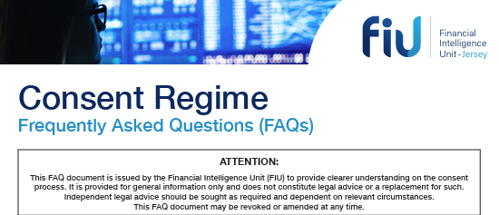
- This FAQ document, issued by Jersey's Financial Intelligence Unit (FIU), is found on the JFSC website [link is found below]
This FAQ
- Provides general guidance on the consent process under Jersey's anti-money laundering (AML) and counter-terrorist financing (CFT) laws, primarily the Proceeds of Crime (Jersey) Law 1999 (POCJL) and related legislation.
- It is not legal advice and assumes familiarity with key laws like POCJL Part 3, Terrorism (Jersey) Law 2002, AML/CFT Handbooks, and the Money Laundering (Jersey) Order 2008.
- The FAQs focus on consent requests under Article 32(4) of POCJL, which offers a defence against offences related to dealing with criminal property if conditions are met.
Key Topics Covered in FAQs
- Legal Basis (Q1): Explains Article 32(4) POCJL, where consent from the FIU protects against offences under Articles 30/31 (dealing/concealing criminal property). References interconnected articles like 29 (criminal property), 34A/34D (failure to disclose), and 35 (tipping off).
- Submission Process (Q2): Consent requests must use the PolSAR Portal (via SAR or Continuation Report). For Schedule 2 businesses, please email/phone if the portal is inaccessible. Please respond within two working days.
- FIU Responses (Q3): Common outcomes include "Consent Provided" (based on current info, doesn't mandate action or cover other offences), "Consent Not Provided" (no rationale required), "Inadequate Information" (requests more details), or "Not a Valid Request" (insufficient to engage Articles 30/31).
- Repeat/Additional Consents (Q4-Q5): Seek new consent for changes, significant transactions, or lapsed time. Please clarify the transaction types. Bundling similar ones (e.g., recurring payments) is acceptable, but not diverse ones.
- Client Management & Tipping Off (Q6, Q9): Continue client interactions without disclosing SAR/investigation; seek "release from tipping off" separately under 2014 Regulations if needed. Releases depend on case specifics; no fixed timeline.
- UK-Jersey Interactions (Q7): UK FIU consent is relevant but not sufficient; separate Jersey consent advised due to differing regimes.
- Response Timelines (Q8): Acknowledgement within two working days; full decision may take longer based on complexity, enquiries, or details provided.
- Allayed Suspicions (Q10): Submit Continuation Report explaining why suspicions are resolved.
- New Suspicions (Q11): Requires a new SAR before consent.
- Unrelated Accounts (Q12): No consent needed if Jersey assets aren't suspected criminal property, but reporting obligations persist.
Additional Guidance
- PolSAR Portal Usage: Explicit consent requests required; implied ones (e.g., "unless you object") are invalid—FIU won't consent by silence.
- General Advice: Emphasises seeking independent legal advice; FIU decisions are case-specific and may evolve.
This FAQ clarifies processes for financial institutions, promoting compliance and effective management of client relationships.
For full details, please see the attached PDF. https://services.jersey.police.uk/PolSAR/assets/doc/consentregimefaqs.pdf
The Team
Meet the team of industry experts behind Comsure
Find out moreLatest News
Keep up to date with the very latest news from Comsure
Find out moreGallery
View our latest imagery from our news and work
Find out moreContact
Think we can help you and your business? Chat to us today
Get In TouchNews Disclaimer
As well as owning and publishing Comsure's copyrighted works, Comsure wishes to use the copyright-protected works of others. To do so, Comsure is applying for exemptions in the UK copyright law. There are certain very specific situations where Comsure is permitted to do so without seeking permission from the owner. These exemptions are in the copyright sections of the Copyright, Designs and Patents Act 1988 (as amended)[www.gov.UK/government/publications/copyright-acts-and-related-laws]. Many situations allow for Comsure to apply for exemptions. These include 1] Non-commercial research and private study, 2] Criticism, review and reporting of current events, 3] the copying of works in any medium as long as the use is to illustrate a point. 4] no posting is for commercial purposes [payment]. (for a full list of exemptions, please read here www.gov.uk/guidance/exceptions-to-copyright]. Concerning the exceptions, Comsure will acknowledge the work of the source author by providing a link to the source material. Comsure claims no ownership of non-Comsure content. The non-Comsure articles posted on the Comsure website are deemed important, relevant, and newsworthy to a Comsure audience (e.g. regulated financial services and professional firms [DNFSBs]). Comsure does not wish to take any credit for the publication, and the publication can be read in full in its original form if you click the articles link that always accompanies the news item. Also, Comsure does not seek any payment for highlighting these important articles. If you want any article removed, Comsure will automatically do so on a reasonable request if you email info@comsuregroup.com.


As well as owning and publishing Comsure's copyrighted works, Comsure wishes to use the copyright-protected works of others. To do so, Comsure is applying for exemptions in the UK copyright law. There are certain very specific situations where Comsure is permitted to do so without seeking permission from the owner. These exemptions are in the copyright sections of the Copyright, Designs and Patents Act 1988 (as amended)[www.gov.UK/government/publications/copyright-acts-and-related-laws]. Many situations allow for Comsure to apply for exemptions. These include 1] Non-commercial research and private study, 2] Criticism, review and reporting of current events, 3] the copying of works in any medium as long as the use is to illustrate a point. 4] no posting is for commercial purposes [payment]. (for a full list of exemptions, please read here www.gov.uk/guidance/exceptions-to-copyright]. Concerning the exceptions, Comsure will acknowledge the work of the source author by providing a link to the source material. Comsure claims no ownership of non-Comsure content. The non-Comsure articles posted on the Comsure website are deemed important, relevant, and newsworthy to a Comsure audience (e.g. regulated financial services and professional firms [DNFSBs]). Comsure does not wish to take any credit for the publication, and the publication can be read in full in its original form if you click the articles link that always accompanies the news item. Also, Comsure does not seek any payment for highlighting these important articles. If you want any article removed, Comsure will automatically do so on a reasonable request if you email info@comsuregroup.com.