




 Published on : 28/05/2026
JFSC 2025 Thematic Examination Feedback on Suspicious Activity Reporting (SAR)
Executive Summary
- The Jersey Financial Services Commission (JFSC) conducted a thematic examination of 9 supervised firms in 2025, focusing on compliance with suspicious activity reporting obligations under the Money Laundering (Jersey) Order 2008 and the AML/CFT/CPF Handbook.
Overall outcome:
- Good level of compliance. 4 out of 9 firms received no findings.
- However, 5 firms had findings, primarily in:
- Policies and procedures
- SAR register and records
- Role and independence of the MLRO
Key message from JFSC:
- All firms received feedback.
- Firms with findings must submit a formal remediation plan with actions and timescales.
Good Practice + Common Findings
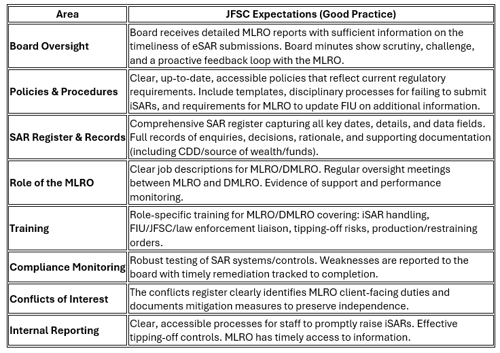
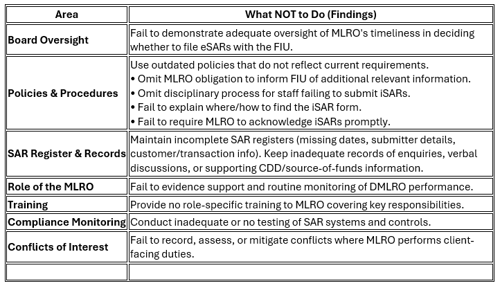
This report highlights what the JFSC expects (good practice) and what not to do (common findings) to help MLROs strengthen their firm's controls.
- What the JFSC Expects (Good Practice)
- What NOT to Do (Common Findings to Avoid)
- Legal & Regulatory Reminders
- Failing to report knowledge or suspicion of ML/TF is a criminal offence (Proceeds of Crime Law & Terrorism Law).
- Employees must raise iSARs "as soon as practicable".
- MLRO must assess and file eSARs promptly.
- Strong controls required to prevent tipping-off.
- Checklist for MLROs
Use this checklist to self-assess your firm's SAR arrangements:
Board Oversight
- Board receives regular, detailed MLRO reports on SAR timeliness and volumes.
- Board minutes document scrutiny and challenge of MLRO reporting.
- A clear feedback loop exists between MLRO and the Board.
Policies & Procedures
- Policies are up-to-date (reviewed regularly) and aligned with the current Handbook.
- Policies cover: iSAR submission, MLRO acknowledgement, disciplinary action for non-reporting, and updating FIU on additional information.
- iSAR form and templates are easily accessible to all staff.
- Tipping-off procedures are clearly documented, and staff are trained.
SAR Register & Records
- SAR register is complete and includes date suspicion arose, date of iSAR, submitter details, customer/transaction details.
- Full records maintained for all enquiries, decisions (including rationale), and supporting documents.
- Records allow quick retrieval of supporting documentation.
MLRO Role & Independence
- Up-to-date job descriptions for MLRO and DMLRO.
- Regular MLRO–DMLRO oversight meetings (if DMLRO is active).
- Conflicts of interest are recorded and mitigated.
- MLRO has adequate authority, resources, and independence.
Training
- All staff receive tailored training on identifying and reporting suspicions.
- MLRO/DMLRO receives role-specific training (iSAR handling, FIU liaison, tipping-off, production orders).
Compliance Monitoring
- Regular testing of SAR systems and controls is performed.
- Results are reported to the Board with remediation plans and tracking.
General
- Effective measures to prevent tipping-off.
- Clear escalation procedures for staff to raise iSARs without delay.
- MLRO has timely access to all relevant information.
Recommended Next Steps for MLROs
- Review your current SAR framework against this checklist.
- Address any gaps immediately.
- Prepare evidence of enhancements (for potential future JFSC engagements).
- Update Board on findings from this thematic review and your remediation actions.
This report and checklist are derived directly from the JFSC's May 2026 Examination Feedback document. MLROs should treat this as a key tool for ongoing compliance and risk mitigation.
Sources
https://www.jerseyfsc.org/media/vrtgwzqn/examination-feedback-suspicious-activity-reporting.pdf
The Team
Meet the team of industry experts behind Comsure
Find out moreLatest News
Keep up to date with the very latest news from Comsure
Find out moreGallery
View our latest imagery from our news and work
Find out moreNews Disclaimer
As well as owning and publishing Comsure's copyrighted works, Comsure wishes to use the copyright-protected works of others. To do so, Comsure is applying for exemptions in the UK copyright law. There are certain very specific situations where Comsure is permitted to do so without seeking permission from the owner. These exemptions are in the copyright sections of the Copyright, Designs and Patents Act 1988 (as amended)[www.gov.UK/government/publications/copyright-acts-and-related-laws]. Many situations allow for Comsure to apply for exemptions. These include 1] Non-commercial research and private study, 2] Criticism, review and reporting of current events, 3] the copying of works in any medium as long as the use is to illustrate a point. 4] no posting is for commercial purposes [payment]. (for a full list of exemptions, please read here www.gov.uk/guidance/exceptions-to-copyright]. Concerning the exceptions, Comsure will acknowledge the work of the source author by providing a link to the source material. Comsure claims no ownership of non-Comsure content. The non-Comsure articles posted on the Comsure website are deemed important, relevant, and newsworthy to a Comsure audience (e.g. regulated financial services and professional firms [DNFSBs]). Comsure does not wish to take any credit for the publication, and the publication can be read in full in its original form if you click the articles link that always accompanies the news item. Also, Comsure does not seek any payment for highlighting these important articles. If you want any article removed, Comsure will automatically do so on a reasonable request if you email info@comsuregroup.com.
Archived News
To find our older articles, please click here.
View archive

To find our older articles, please click here.