




 Published on : 24/06/2026
JFSC Codes vs Guidance – What Is Mandatory [and why] in the Updated AML/CFT/CPF Handbook
The Jersey Financial Services Commission (JFSC) has made it clear that not everything in the AML/CFT/CPF Handbook carries the same weight.
Following the publication of the updated AML/CFT/CPF Handbook (effective 31 May 2026) and the upcoming Money Laundering (Jersey) Amendment Order 2026 (effective 30 June 2026), the JFSC has reinforced an important distinction that all compliance professionals should understand.
The Key Difference: Codes of Practice vs Guidance Notes
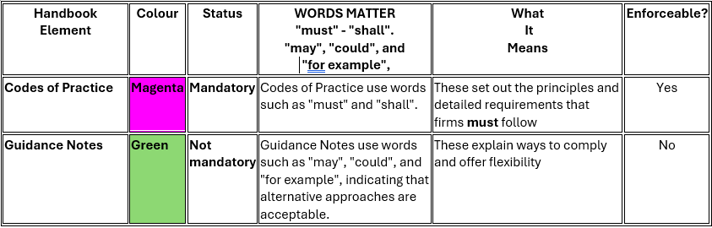
The Handbook uses a simple colour-coded system to show what is mandatory and what is not:
JFSC Position Confirmed in Consultation
- During recent consultations on enhancements to the Handbook, the JFSC explicitly reiterated that guidance is not mandatory. This longstanding position has now been made even clearer in the updated Handbook.
- Key Source:
- Feedback on enhancements to the AML/CFT/CPF Handbook (Published: November 2025)
- Direct Quote (Page 21 / Section 2.14):
- "We reiterate the position that guidance IS NOT mandatory.
- We support and are committed to working with industry to deliver a streamlined and user-friendly Handbook."
- Official Document: https://www.jerseyfsc.org/media/0aejq3yo/feedback-on-enhancements-to-the-aml-cft-cpf-handbook.pdf
- The JFSC's position is also clearly set out in the updated Handbook itself (Section 1 – Introduction), where it states:
- "Guidance notes present ways of complying with the statutory requirements and AML/CFT/CPF Codes of Practice and must always be read in conjunction with these.
- A supervised person may adopt other measures to those set out in the guidance notes… so long as it can demonstrate that such measures also achieve compliance…"
- This confirms that Guidance is not a "must" rule.
Why This Matters Now
- The Money Laundering (Jersey) Amendment Order 2026 introduces a new statutory definition of "Relevant Code of Practice".
- This definition only refers to the mandatory Codes of Practice issued under Article 22 of the Proceeds of Crime (Supervisory Bodies) Law.
- This means:
- When the MLJO (as amended) requires monitoring or risk-based decisions to be made by reference to a "relevant Code of Practice", it is referring to the magenta Codes, not the green Guidance.
- Firms can continue to use alternative approaches where Guidance suggests one method, provided they can still meet the mandatory Codes of Practice and the requirements of the Money Laundering Order.
Understanding the Real Risk of Deviating from Guidance
- It is important to understand where the risk actually lies.
- There is no daily compliance obligation to follow JFSC Guidance, as it is not mandatory.
- However, the real risk arises if a breach of a Code of Practice (or financial crime law) occurs.
- In such circumstances:
- Firms that followed the relevant JFSC Guidance have a stronger position and can point to having taken reasonable steps in line with the regulator's published expectations.
- Firms that ignored the Guidance and followed their own approach may find they have no safe harbour or reasonable defence. They will likely face greater scrutiny and will need to demonstrate why their alternative measures were equally effective.
- "No safe harbour or reasonable defence" means:
- If a breach of a Code of Practice (or financial crime requirement) occurs and the firm did not follow JFSC Guidance, it will be much harder to show that it took reasonable steps to comply.
- In practice, following JFSC Guidance provides a form of protection (safe harbour). Ignoring it removes this protection, increasing regulatory risk if something goes wrong.
- In short:
- While you do not have to follow Guidance on a day-to-day basis, choosing not to do so removes an important layer of protection if something goes wrong.
Practical Takeaway for Jersey Firms
- Treat magenta Codes of Practice as binding rules.
- Use green Guidance as helpful support, not as additional "must-do" requirements.
- When documenting decisions (especially risk-based decisions around the MLCO role from 30 June 2026), be clear whether you are choosing an alternative approach to comply with the Codes as recommended by JFSC Guidance.
- If you choose to deviate from Guidance, document your reasoning and evidence that your approach achieves equivalent compliance; this becomes particularly important if a breach or issue later arises.
- The distinction helps maintain a proportionate and risk-based approach while giving firms clarity on where regulatory expectations are firm and where there is room for flexibility.
Sources
Official JFSC Sources
- Updated AML/CFT/CPF Handbook (effective 31 May 2026): https://www.jerseyfsc.org/industry/financial-crime/amlcftcpf-handbooks/amlcftcpf-handbook/
- JFSC News – Updated AML/CFT/CPF Handbook and Upcoming Changes: https://www.jerseyfsc.org/news-and-events/updated-amlcftcpf-handbook-and-upcoming-changes/
- Feedback on enhancements to the AML/CFT/CPF Handbook (November 2025): https://www.jerseyfsc.org/media/0aejq3yo/feedback-on-enhancements-to-the-aml-cft-cpf-handbook.pdf
Industry Analysis
- Comsure – JFSC AML/CFT/CPF Handbook Goes Live 31 May 2026: http://www.comsuregroup.com/news/jfsc-amlcftcpf-handbook-goes-live-31-may-2026-but-major-mlco-changes-follow-just-one-month-later/
Related Legislation
- Money Laundering (Jersey) Amendment Order 2026 (full text): https://www.jerseylaw.je/laws/enacted/Pages/RO-077-2026.aspx
The Team
Meet the team of industry experts behind Comsure
Find out moreLatest News
Keep up to date with the very latest news from Comsure
Find out moreGallery
View our latest imagery from our news and work
Find out moreNews Disclaimer
As well as owning and publishing Comsure's copyrighted works, Comsure wishes to use the copyright-protected works of others. To do so, Comsure is applying for exemptions in the UK copyright law. There are certain very specific situations where Comsure is permitted to do so without seeking permission from the owner. These exemptions are in the copyright sections of the Copyright, Designs and Patents Act 1988 (as amended)[www.gov.UK/government/publications/copyright-acts-and-related-laws]. Many situations allow for Comsure to apply for exemptions. These include 1] Non-commercial research and private study, 2] Criticism, review and reporting of current events, 3] the copying of works in any medium as long as the use is to illustrate a point. 4] no posting is for commercial purposes [payment]. (for a full list of exemptions, please read here www.gov.uk/guidance/exceptions-to-copyright]. Concerning the exceptions, Comsure will acknowledge the work of the source author by providing a link to the source material. Comsure claims no ownership of non-Comsure content. The non-Comsure articles posted on the Comsure website are deemed important, relevant, and newsworthy to a Comsure audience (e.g. regulated financial services and professional firms [DNFSBs]). Comsure does not wish to take any credit for the publication, and the publication can be read in full in its original form if you click the articles link that always accompanies the news item. Also, Comsure does not seek any payment for highlighting these important articles. If you want any article removed, Comsure will automatically do so on a reasonable request if you email info@comsuregroup.com.
Archived News
To find our older articles, please click here.
View archive

To find our older articles, please click here.