




 Published on : 05/06/2026
Shock at the FSC: CEO Quits After Just 9 Months, Six Months Ahead of the 2027 AML Assessment
Mauritius' financial regulator is once again in the spotlight for all the wrong reasons.
Just nine months after taking the helm, Désiré Vencatachellum has resigned as Chief Executive of the Financial Services Commission (FSC), effective 30 June 2026. The sudden departure has revived serious concerns about institutional stability at a regulator whose credibility is vital for Mauritius' reputation as an international financial centre, especially with the country's next major AML/CFT assessment by the ESAAMLG looming in 2027.
A Familiar Story of Instability
This is not the first time the FSC has been left leaderless at a critical moment.
In November 2024, Dr Roshan Boodhoo stepped down, leaving the regulator without a permanent CEO for almost ten months.
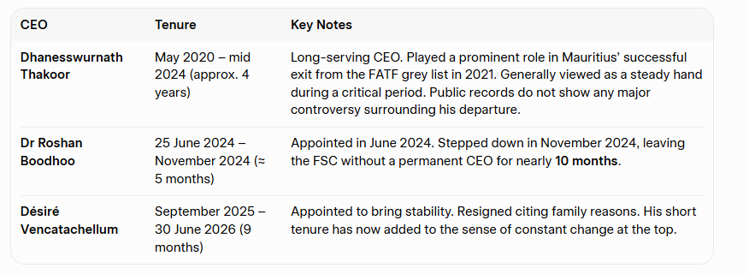
Vencatachellum's appointment in September 2025 was meant to end that period of uncertainty. Instead, it has become just another short chapter in a worrying pattern of leadership churn.
In its official statement on 29 May 2026, the FSC Board said Vencatachellum cited "personal and family reasons" requiring his presence abroad. The Board thanked him for his contribution and said "temporary arrangements" would be put in place under its supervision.
Industry and Political Voices Raise Red Flags
Not everyone is convinced the official explanation tells the full story.
Opposition figure and former Minister of Financial Services Mahen Seeruttun welcomed the stated reasons "with caution," suggesting the real circumstances remain unclear. Several financial sector professionals (speaking anonymously) have criticised the outgoing CEO for limited accessibility and weak communication with the industry, particularly during the regular "Industry meets" sessions.
More broadly, many in the sector are concerned about the stability of governance at the FSC itself. The recent change in Board presidency, combined with the latest CEO exit, has created a perception of constant upheaval at the top of the regulator.
Shamima Mallam-Hassam, Managing Director of Trident Trust, warned that a prolonged period under an interim Officer-in-Charge "could fuel questions about the stability of the organisation." She stressed the urgent need for a permanent, qualified CEO to reassure investors and the international community.
Why This Matters: The 2027 ESAAMLG Assessment
What makes this resignation particularly sensitive is the timing.
Mauritius is preparing for its next mutual evaluation by the Eastern and Southern Africa Anti-Money Laundering Group (ESAAMLG), the regional body that assesses countries on anti-money laundering (AML) and counter-terrorist financing (CFT) standards. This assessment, expected to involve an on-site visit around 2027, will scrutinise how effectively Mauritius supervises its financial sector.
The FSC is one of the key pillars of this system. Assessors will look closely at the regulator's ability to deliver consistent, risk-based supervision, licensing, and enforcement. Repeated leadership changes make it harder to demonstrate strong institutional capacity and continuity, exactly what international evaluators want to see.
As Seeruttun noted, an FSC without stable direction at this delicate time sends "a particularly unwelcome signal" to the international financial community.
Government Reassures, But Pressure Mounts for Quick Action
Minister of Financial Services Dr Jyoti Jeetun has tried to calm nerves. She pointed out that 16 government agencies are involved in the ESAAMLG preparations and that the FSC has over 300 staff plus a management structure capable of ensuring continuity. She expressed confidence in the Board to manage the transition.
However, many in the industry argue that day-to-day regulatory leadership cannot be effectively handled by the Board alone for long. Calls are growing for a permanent, high-calibre successor to be appointed before 30 June to avoid any disruption.
The Bigger Picture for Mauritius
Mauritius has worked hard to build its reputation as a credible and well-regulated international financial centre after exiting the FATF grey list in 2021. The financial services sector contributes significantly to GDP and employs thousands of Mauritians.
Any perception of regulatory weakness or instability risks damaging that hard-won credibility at the worst possible time.
The next CEO will need to do more than just steady the ship. They will need to project strength, accessibility, and competence to both the local industry and international observers closely watching Mauritius.
Read news update - It has been reported:
Nine months after he took the helm of the Financial Services Commission, Désiré Vencatachellum will leave his position on 30 June. A resignation that revives concerns about the stability of the regulator.
The Financial Services Commission (FSC) of Mauritius is once again faced with a vacancy at its head. Désiré Vencatachellum, appointed Chief Executive of the financial sector regulator in September 2025, announced his resignation on May 29, citing family reasons.
His departure, effective June 30, 2026, comes just nine months after he took office, reviving concerns about the institutional stability of a regulator whose international credibility is directly at stake.
This departure is not the first to weaken the institution.
- In November 2024, Dr Roshan Boodhoo left his position, leaving the FSC without leadership for almost ten months.
- The appointment of Désiré Vencatachellum, in September 2025, had been presented as the end of a long period of uncertainty. It was only a parenthesis.
In its press release on 29 May, the FSC board of directors said that its Chief Executive had justified his decision by the need to be present abroad for personal and family reasons.
The institution welcomed his contribution, while assuring that "temporary arrangements" (see below) would be put in place to ensure continuity of operations under the supervision of the Board of Directors.
These explanations did not convince everyone. Mahen Seeruttun, a former minister of financial services and an opposition figure, says he welcomes the reasons officially put forward "with caution". Without specifying what he means by this, he suggests that the real circumstances of the departure remain unclear.
This reservation is shared, on condition of anonymity, by several professionals in the financial sector, who paint a more critical picture of the relationship between the outgoing management and the market's operators.
Some of them criticise Désiré Vencatachellum for lacking accessibility and for maintaining insufficient communication with the various components of the industry, particularly during the "Industry meets", the periodic meetings organised by the regulator with the sector's players. These grievances reflect a tense relationship between the regulator and the actors it supervises.
An instability that worries the sector
For Mahen Seeruttun, the problem goes beyond Désiré Vencatachellum.
- It is the institution's overall governance that seems to be weakened. The FSC has also recently changed its presidency, a fact that the former minister cites as a distinct element, adding to the succession of departures in the executive leadership and reinforcing the perception of governance in permanent motion. "Several operators in the sector are already expressing frustration with certain unmet expectations of the regulator," he said, seeing this new start as a worrying signal to the international financial community.
This sentiment is shared by Shamima Mallam-Hassam, Managing Director of Trident Trust, whose voice is heard in Mauritian financial circles.
- It considers it essential that the appointment of a new Chief Executive take place as soon as possible, considering that an extended period under the responsibility of an Officer-in-Charge, i.e. an interim director without a full mandate, "could fuel questions about the stability of the organisation". For her, the challenge is also to reassure investors and the business community about the ability of the FSC to fulfil its supervisory and regulatory missions fully.
Anonymous professionals go further:
- A regulator, they say, cannot function sustainably without its own executive management. The board of directors has a supervisory role, not a day-to-day management role.
- They are pleading for a successor to be appointed before June 30 to avoid any break in the conduct of affairs.
What all these actors have in mind, without always formulating it explicitly, is the imminent assessment that Mauritius must undergo before the ESAAMLG (Group for the Fight against Money Laundering in Eastern and Southern Africa).
This evaluation, which will assess the robustness of the anti-money laundering and counter-terrorism financing system, is a significant event for the Mauritian jurisdiction's reputation on the international stage.
Mahen Seeruttun believes that the resignation of Désiré Vencatachellum comes "at a delicate time.
An FSC without stable direction at the time of such an assessment would be a particularly unwelcome signal. The future holder of the position, he said, will have to "possess the necessary skills to send a clear message to the financial industry as well as to the international bodies that follow the evolution of the Mauritian jurisdiction". He adds that the recruitment process should be designed to allow the most qualified candidates to apply.
The Minister of Financial Services, Dr Jyoti Jeetun, took note of the resignation and joined in thanking the outgoing leader, wishing him success in his future endeavours. It's reassuring: it notes that sixteen government agencies are involved in preparing for the evaluation of the ESAAMLG, and that the FSC is one of its pillars. She points out that the institution employs more than 300 people and has a management structure capable of ensuring the continuity of its activities, adding that she trusts the board of directors to manage the transition.
The COO, a figure of the interim or a candidate for succession?
According to sources close to the matter, the board of directors approved the appointment of a Chief Operating Officer (COO) at its May 29 meeting, the same day the resignation was announced. Some people are asking why this person wasn't directly approached for the Chief Executive role, given the experience already present within the FSC's management.
The question of succession is now in the hands of the Minister of Financial Services and the Prime Minister, who will have to agree on the next leader's profile. According to the information gathered, the two parties intend not to take any "reckless risks" - to use the phrase in circles close to the matter - and to ensure that the future Chief Executive is truly "up to the challenge".
When he took office, Désiré Vencatachellum had nevertheless set an ambitious course: to preserve the stability and integrity of the financial system, to promote innovation, growth and financial inclusion, but also to insist on "the importance of compliance with regulatory and governance standards to consolidate Mauritius' reputation as a credible international financial centre".
Nine months later, it is precisely this credibility that his premature departure is testing.
Sources & Further Reading
Official FSC Sources:
- FSC Official Communiqué – Resignation of the Chief Executive (29 May 2026): https://www.fscmauritius.org/media/xmbmru52/communiqué_chief-executive-resignation-may-29-2026.pdf
- Financial Services Commission Mauritius (Main Website): https://www.fscmauritius.org/
Assessment Context:
- ESAAMLG Website (Mutual Evaluations): https://www.esaamlg.org/
- FATF Page on Mauritius: https://www.fatf-gafi.org/en/countries/detail/Mauritius.html
News Coverage:
- News Moris – FSC CEO Désiré Vencatachellum to Step Down: https://newsmoris.com/fsc-ceo-desire-vencatachellum-to-step-down-on-30-june-after-year/
- Defi Media (Facebook post with details): https://www.facebook.com/www.defimedia.info/posts/fsc-d%C3%A9sir%C3%A9-vencatachellum-quittera-ses-fonctions-de-chief-executive-%C3%A0-la-fin-du-/1424680543017569/
The Team
Meet the team of industry experts behind Comsure
Find out moreLatest News
Keep up to date with the very latest news from Comsure
Find out moreGallery
View our latest imagery from our news and work
Find out moreNews Disclaimer
As well as owning and publishing Comsure's copyrighted works, Comsure wishes to use the copyright-protected works of others. To do so, Comsure is applying for exemptions in the UK copyright law. There are certain very specific situations where Comsure is permitted to do so without seeking permission from the owner. These exemptions are in the copyright sections of the Copyright, Designs and Patents Act 1988 (as amended)[www.gov.UK/government/publications/copyright-acts-and-related-laws]. Many situations allow for Comsure to apply for exemptions. These include 1] Non-commercial research and private study, 2] Criticism, review and reporting of current events, 3] the copying of works in any medium as long as the use is to illustrate a point. 4] no posting is for commercial purposes [payment]. (for a full list of exemptions, please read here www.gov.uk/guidance/exceptions-to-copyright]. Concerning the exceptions, Comsure will acknowledge the work of the source author by providing a link to the source material. Comsure claims no ownership of non-Comsure content. The non-Comsure articles posted on the Comsure website are deemed important, relevant, and newsworthy to a Comsure audience (e.g. regulated financial services and professional firms [DNFSBs]). Comsure does not wish to take any credit for the publication, and the publication can be read in full in its original form if you click the articles link that always accompanies the news item. Also, Comsure does not seek any payment for highlighting these important articles. If you want any article removed, Comsure will automatically do so on a reasonable request if you email info@comsuregroup.com.
Archived News
To find our older articles, please click here.
View archive

To find our older articles, please click here.