




 Published on : 13/04/2026
The Jersey Trust, Quidnet REIT and Richard Tice’s Dividend Tax Row
What is this all about
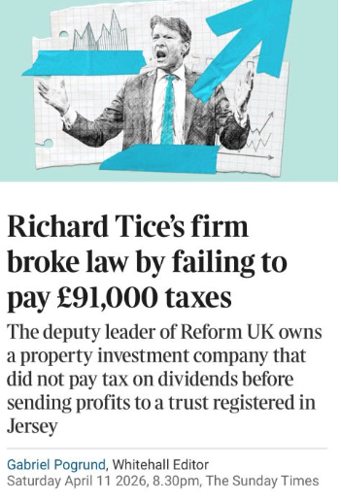
- Recent media reporting has raised questions about the tax treatment of dividends paid by Quidnet REIT Ltd, a property investment company controlled by entities linked to Richard Tice, deputy leader of Reform UK.
- The coverage focuses on whether the company followed specific withholding tax procedures on distributions made between 2020 and 2022, rather than on the overall legitimacy of the REIT structure itself.
- The central issue concerns whether Quidnet REIT deducted and remitted the required 20% basic rate income tax (withholding tax) on certain dividends classified as Property Income Distributions (PIDs).
- UK REIT rules generally require, subject to classification, companies to withhold this tax at source on PIDs paid to most individuals and non-UK trusts, and to pay it directly to HM Revenue & Customs (HMRC).
- This obligation is separate from any income tax the recipients may later pay themselves.
- The matter was first highlighted by The Sunday Times and has been examined in detail by tax specialist Dan Neidle of Tax Policy Associates AND James Quarmby, Founding Partner, Private Wealth, Stephenson Harwood LLP
- Importantly, there is no allegation of deliberate wrongdoing, fraud or criminal activity.
- James Quarmby says:- as we don’t have the full facts, but to me this looks like an administrative breach rather than tax avoidance [ https://tinyurl.com/udakjckr]
-
- This article is based solely on publicly available reporting, analyses, and statements. Tax positions can only be definitively resolved by HMRC or through full disclosure of the underlying records.
- Readers seeking primary sources are encouraged to review the company filings on Companies House and the detailed analysis published by Tax Policy Associates.
- Importantly, there is no allegation of deliberate wrongdoing, fraud or criminal activity.Executive Summary
- In simple terms, the story concerns how a UK property company linked to Richard Tice paid out profits to its owners.
- Between 2020 and 2022, Quidnet REIT Ltd distributed around £600,000 to Mr Tice personally and to a Jersey family trust connected to him.
- Quidnet REIT was controlled through a Jersey‑law trust, with a UK professional trustee (City Trustees, part of Mattioli Woods), which is why Mattioli Woods appears as PSC.
- https://find-and-update.company-information.service.gov.uk/company/09718143/persons-with-significant-control
- Under special rules that apply to this type of company (called a REIT), when profits from rental property are paid out in a certain way, the company is normally required to deduct 20% tax at the time of payment and send it directly to HMRC much like an employer deducts tax from wages before paying staff.
- Public analysis of the company’s accounts and filings, carried out by tax expert Dan Neidle, found no clear evidence that this 20% deduction (estimated at roughly £119,000–£120,000) was made and paid by the company at the time.
- Richard Tice has responded by saying the matter is technical, that he personally paid income tax at the highest rate on the amounts he received, and that HMRC ultimately received the full tax due. Reform UK has described it as a minor administrative issue with no net loss to the public finances.
- Tax specialists differ in their views.
- Some note that REIT rules are highly complex and that, without full internal records, it is difficult to reach firm conclusions from public information alone.
- Others stress that the law places a clear upfront responsibility on the company itself, separate from what shareholders pay later.
- Importantly, there is no allegation of deliberate wrongdoing, fraud or criminal activity.
- The reporting focuses on the correct timing and procedure for collecting tax, not on whether less tax was paid overall.
- HMRC has not commented publicly, as is standard in such cases. The full facts would ultimately depend on the company’s detailed records and HMRC’s assessment.
- This summary is based solely on publicly available reporting and analysis. It aims to explain why the story has appeared without assuming any breach has been proven
Background on Quidnet REIT and the Dividends
- Quidnet REIT Ltd obtained UK REIT status in August 2018 and exited the regime in August 2021. During this period, the company made substantial distributions to its shareholders, including Richard Tice personally and a Jersey-based family trust linked to him.
- Analyses of public filings (including Companies House accounts and stock exchange announcements) indicate that approximately £596,000–£600,000 in dividends were paid to Mr Tice and the trust between 2020 and 2022. These figures have not been publicly disputed.
How REIT Withholding Tax Works
- Under UK tax law, a qualifying REIT pays no corporation tax on its property rental profits provided it distributes at least 90% of those profits as PIDs.
- For most recipients (including UK individuals and non-UK trusts), the REIT is required to deduct 20% withholding tax on PIDs and remit it to HMRC. This mechanism is often compared to PAYE withholding on wages.
- Distributions that are not classified as PIDs (for example, from other income sources) are not subject to this mandatory withholding. Scrip dividends (paid in shares rather than cash) add further technical complexity, as the company must still account for any applicable withholding.
The Allegation Regarding Withholding Tax
- Dan Neidle’s analysis of the company’s public accounts and filings concludes there is no clear evidence that Quidnet REIT deducted or paid the required 20% withholding tax on the dividends paid to Mr Tice and the Jersey trust.
- Key points raised in the analysis include:
- Cash-flow statements that do not appear to record payments to HMRC consistent with 20% PID withholding.
- Scrip dividend share issuances recorded at gross (pre-tax) values.
- Allotments of shares that align with full pre-tax dividend amounts, without visible adjustment or separate tax payment.
- On this basis,
- Neidle estimates that around £119,000–£120,000 in withholding tax may not have been paid by the company.
- The Sunday Times initially reported a lower figure of at least £91,000.
Responses from Richard Tice and Reform UK
- Richard Tice has described the reporting as a “technicality” and a “smear.”
- He has stated publicly that he paid income tax at the highest marginal rate on all dividends received and that, overall, “HMRC has been paid in full” and received the correct amount of tax due.
- Reform UK has characterised the matter as a “minor administrative error” and a “non-story,” arguing that Mr Tice’s personal tax payments would have offset any shortfall in withholding by the company.
- Mr Tice has not publicly released full details of the dividend classifications (PID vs non-PID), specific HMRC correspondence on the withholding point, or the exact tax treatment applied by the Jersey trust.
Differing Expert Perspectives
- Tax professionals have offered varying interpretations.
- James Quarmby, a private wealth partner at Stephenson Harwood LLP, has commented on the complexity of REIT rules. He has noted that, without access to full company accounts and confirmation of whether the dividends in question were classified as Property Income Distributions (PIDs) or non-PIDs, outsiders cannot reach definitive conclusions from public information alone. If the recipients ultimately paid the full tax due at their marginal rates, he suggests the issue may amount to a procedural matter rather than substantive tax avoidance.
- Source for Quarmby:
- LinkedIn post by James Quarmby (April 2026): https://www.linkedin.com/posts/james-quarmby-24327411_labour-urges-tax-investigation-into-reforms-activity-7439584372938162179-naHK (and related threads discussing REITs, PIDs, and the Tice story).
- Dan Neidle, Dan Neidle of Tax Policy Associates, takes a stricter position. He argues that the law places a clear, mandatory obligation on the REIT itself to withhold and remit the 20% tax upfront on qualifying PIDs. This obligation cannot be satisfied simply by the shareholders paying income tax later on their own returns. In his analysis, any failure to withhold would constitute a breach of tax procedure, potentially leading to HMRC assessments for tax, interest, and civil penalties even if there was ultimately no net loss of revenue to the Exchequer.
- Source for Neidle:
- Main report by Dan Neidle / Tax Policy Associates (11 April 2026): https://taxpolicy.org.uk/2026/04/11/richard-tice-company-failed-to-pay-120k-tax-dividends/
- LinkedIn post summarising the findings: https://www.linkedin.com/posts/danneidle_richard-tices-property-company-failed-to-activity-7448819441016033281-Bi4J
- Related Guardian coverage referencing Neidle’s analysis: https://www.theguardian.com/uk-news/2026/apr/12/richard-tice-reform-uk-quidnet-reit-tax-dividends
Current Status of the Dispute
- From publicly available information, the following points appear clear:
- If the dividends were Property Income Distributions, UK REIT rules required Quidnet REIT to deduct and remit 20% withholding tax at source.
- Independent analysis of published accounts has questioned whether that withholding occurred.
- The precise classification of the dividends and HMRC’s view of the position have not been publicly confirmed.
- There is no public allegation or evidence of criminal intent, fraud, or deliberate concealment. The dispute centres on the mechanics and timing of tax payment rather than on whether Mr Tice or the trust paid less tax overall than was due.
- HMRC does not normally comment on individual cases. It remains unknown whether the authority is actively reviewing Quidnet REIT’s filings in light of the publicity.
Why This Matters
- The episode illustrates how technically complex REIT rules can be, especially when applied to closely held companies involving offshore trusts.
- For the public and for political figures, the focus is likely to remain on questions of transparency and adherence to procedural requirements, even where no net tax loss is ultimately alleged.
Jersey trust/trustee risk
- The Jersey trust is mentioned in stories only as a recipient of the dividends in question.
- There is no public indication of any direct trouble, penalty, or investigation targeting the trust or its Jersey trustee.
- Any future HMRC action would most likely start with the UK company (Quidnet) and could extend to the recipients only if tax discrepancies are found.
Warning
-
Sources
Key Public Sources for Attribution/Footnotes (as of April 2026)
- Dan Neidle / Tax Policy Associates detailed report: https://taxpolicy.org.uk/2026/04/11/richard-tice-company-failed-to-pay-120k-tax-dividends/
- The Guardian coverage of the Sunday Times story: https://www.theguardian.com/uk-news/2026/apr/12/richard-tice-reform-uk-quidnet-reit-tax-dividends
- Companies House filing search for Quidnet REIT Limited (company number 09718143): https://find-and-update.company-information.service.gov.uk/company/09718143
Primary Analysis from Tax Expert Dan Neidle (Tax Policy Associates)
- Main report on the £120k withholding tax issue (detailed forensic analysis of company filings, with evidence from accounts): https://taxpolicy.org.uk/2026/04/11/richard-tice-company-failed-to-pay-120k-tax-dividends/
- Dan Neidle’s LinkedIn post summarising the findings: https://www.linkedin.com/posts/danneidle_richard-tices-property-company-failed-to-activity-7448819441016033281-Bi4J
Mainstream News Coverage of the Latest Allegations
- The Guardian (12 April 2026) – clear summary of the Sunday Times story and Neidle’s £120k figure: https://www.theguardian.com/uk-news/2026/apr/12/richard-tice-reform-uk-quidnet-reit-tax-dividends
- Daily Mirror (recent) – covers the failure to withhold on dividends worth £456k and Tice’s response: https://www.mirror.co.uk/news/politics/richard-tice-reform-tax-farage-37001055
- BBC (earlier related piece on the £600k corporation tax story and Labour’s call for investigation): https://www.bbc.co.uk/news/articles/clyz0ep9g8lo
James Quarmby’s Commentary (the one you shared)
James Quarmby’s detailed LinkedIn posts on REITs, PIDs, withholding tax, and why this appears to be an administrative breach rather than serious avoidance are widely referenced in tax discussions. You can find them by searching his name + “REIT” or “Tice” on LinkedIn:
- Example post/thread discussing the REIT rules and Tice story: Search directly on LinkedIn for “James Quarmby” + “Labour urges tax investigation” or “Richard Tice’s REIT” (posts from early April 2026).
- https://www.linkedin.com/posts/james-quarmby-24327411_did-richard-tices-reit-break-the-law-share-7449342081837371392-pa2X?utm_source=share&utm_medium=member_desktop&rcm=ACoAAAA_6EIB0wPAWyjQcuq_XiD3asUV8xpMeZ0
Richard Tice’s & Reform UK’s Response
- Tice’s statements calling it a “technicality” and insisting “HMRC has been paid in full” are quoted in most articles above (Guardian, Mirror, etc.).
- Earlier response on the £600k corporation tax story: https://timesofindia.indiatimes.com/world/uk/there-is-no-obligation-to-pay-more-tax-richard-tice-hits-back-as-labour-calls-for-probe-over-600k-tax-row/articleshow/129612275.cms
Official Rules on REITs & Withholding Tax (for background)
- HMRC internal manual on REIT distributions and withholding: https://www.gov.uk/hmrc-internal-manuals/investment-funds/ifm28210 https://www.gov.uk/hmrc-internal-manuals/investment-funds/ifm28005
- General explanation of PID vs non-PID and 20% withholding: https://www.pinsentmasons.com/out-law/guides/tax-treatment-of-reits
Companies House / Filings
You can search for Quidnet REIT Limited (company number 09718143) directly on the UK Companies House website for the actual accounts: https://find-and-update.company-information.service.gov.uk/company/09718143
-
The Team
Meet the team of industry experts behind Comsure
Find out moreLatest News
Keep up to date with the very latest news from Comsure
Find out moreGallery
View our latest imagery from our news and work
Find out moreNews Disclaimer
As well as owning and publishing Comsure's copyrighted works, Comsure wishes to use the copyright-protected works of others. To do so, Comsure is applying for exemptions in the UK copyright law. There are certain very specific situations where Comsure is permitted to do so without seeking permission from the owner. These exemptions are in the copyright sections of the Copyright, Designs and Patents Act 1988 (as amended)[www.gov.UK/government/publications/copyright-acts-and-related-laws]. Many situations allow for Comsure to apply for exemptions. These include 1] Non-commercial research and private study, 2] Criticism, review and reporting of current events, 3] the copying of works in any medium as long as the use is to illustrate a point. 4] no posting is for commercial purposes [payment]. (for a full list of exemptions, please read here www.gov.uk/guidance/exceptions-to-copyright]. Concerning the exceptions, Comsure will acknowledge the work of the source author by providing a link to the source material. Comsure claims no ownership of non-Comsure content. The non-Comsure articles posted on the Comsure website are deemed important, relevant, and newsworthy to a Comsure audience (e.g. regulated financial services and professional firms [DNFSBs]). Comsure does not wish to take any credit for the publication, and the publication can be read in full in its original form if you click the articles link that always accompanies the news item. Also, Comsure does not seek any payment for highlighting these important articles. If you want any article removed, Comsure will automatically do so on a reasonable request if you email info@comsuregroup.com.
Archived News
To find our older articles, please click here.
View archive

To find our older articles, please click here.