

UK FCA Issues New Guidance on Reporting Sanctions Evasion by other firms!!!!
17/02/2026
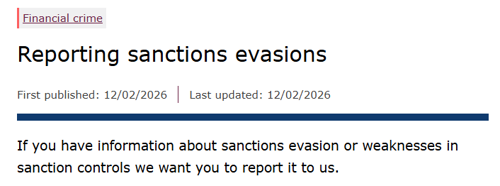
The UK Financial Conduct Authority (FCA) has released new and updated guidance to strengthen the reporting of sanctions evasion across the UK financial sector.
- The publication, dated 12 February 2026, provides clarity on what firms and professionals should report, how to report it, and the FCA’s expectations for effective sanctions‑control frameworks.
- https://www.fca.org.uk/firms/financial-crime/financial-sanctions/reporting-sanctions-evasions
CLEAR ROUTES FOR REPORTING SANCTIONS EVASION
The FCA outlines several reporting pathways depending on the nature of the information:
- Whistleblowing for Confidential Concerns
- Individuals who wish to report concerns about their current or previous employer or who require anonymity are directed to the FCA’s Whistleblowing team for confidential reporting.
- Reporting by Authorised Firms
- Firms reporting issues within their own organisation, where anonymity is not required, are advised to follow the notification rules set out in SUP 15 of the FCA Handbook.
- Reporting Misconduct by Other Firms or Individuals
- Industry professionals with information about potential sanctions‑evasion activity by third parties are encouraged to use the FCA’s dedicated wrongdoing or misconduct reporting form, including the option to attach relevant documentary evidence.
- The FCA emphasises that providing contact details helps them follow up, though anonymous reporting is still permitted.
OTHER LEGAL RESPONSIBILITIES STILL APPLY
The FCA stresses that reporting to the regulator does not replace statutory duties under laws such as:
- The Proceeds of Crime Act 2002
- The Sanctions and Anti-Money Laundering Act 2018
Other UK authorities, particularly
- Firms must continue to comply with sector-specific reporting rules, including those overseen by other supervisory bodies (e.g., HMRC, ACCA, or relevant professional bodies).
Reporting information to OFSI – what to do
- The Office of Financial Sanctions Implementation (OFSI) also impose separate mandatory reporting obligations for “relevant firms.” These include financial institutions, auditors, legal practitioners, and certain trust and company service providers who must notify OFSI if they know or suspect that an individual is designated or has breached sanctions.
- https://www.gov.uk/guidance/suspected-breach-of-financial-sanctions-what-to-do
A Renewed Regulatory Focus on Sanctions Risks
- The FCA notes that it wants to hear about any sanctions‑evasion issues or weaknesses in sanctions controls that relate to firms or individuals listed on its registers, or companies with UK-listed securities.
- This includes suspected and actual breaches, typologies used to circumvent sanctions, and indicators of weak sanctions controls within financial institutions.
- The renewed focus comes amid heightened geopolitical tensions and follows additional FCA enforcement and guidance activity in recent years.
- The updated FCA guidance as part of the UK’s wider sanctions compliance landscape and ongoing expectations for firms to strengthen their oversight and reporting mechanisms.
A Strengthened Focus on Sanctions Controls
In its updated material, the FCA emphasises that it expects firms and individuals to report any concerns relating to sanctions evasion, including:
- Weaknesses in sanctions‑control frameworks
- Suspected breaches of sanctions
- Actual confirmed breaches of sanctions
- Any methods, typologies, or behaviours that could indicate attempts to circumvent UK financial‑sanctions laws
The guidance applies to issues relating to any firm or individual appearing on the FCA’s registers or connected to UK-listed securities. This reflects the regulator’s increased focus on keeping sanctions compliance aligned with geopolitical developments and international financial crime risks.
Senior Management Accountability
The guidance underscores that sanctions compliance is a board‑level priority. Senior management should:
- Take clear ownership of sanctions-related risks
- Ensure regular flow of management information relating to sanctions
- Oversee any outsourced or externally supported sanctions‑screening processes
- Promote consistent compliance across all business lines, including group-level structures
The FCA expects firms to maintain strong and adaptable compliance frameworks, especially when sanctions-relevant risks evolve, or new sanctions regimes come into force.
Strengthened Governance and Senior Management Accountability
Sanctions compliance continues to be treated as a board‑level responsibility. FCA guidance within the Financial Crime Guide and related publications underscores that senior management should:
- Take clear ownership of sanctions risk
- Receive regular and ad hoc management information
- Ensure enhanced oversight where sanctions controls rely on outsourced or external resources
- Promote coordinated compliance across jurisdictions within multinational groups
Broader Sanctions‑Compliance Landscape
- Separate UK guidance from other authorities, including the Office of Financial Sanctions Implementation (OFSI), outlines further mandatory reporting duties for “relevant firms,” such as financial institutions, auditors, legal professionals, accountancy service providers, and trust or company service providers. These obligations include reporting designated persons, suspected breaches, and details of any frozen assets.
- Together, these frameworks form a comprehensive regulatory environment intended to ensure that the UK’s financial system is not used to circumvent sanctions aimed at geopolitical, security, or financial‑crime threats.
What This Means for Firms
The FCA’s renewed emphasis signals that sanctions‑compliance deficiencies will face increasing scrutiny. Firms should:
- Review their sanctions policies and screening systems
- Ensure CDD processes identify complex ownership structures and unusual activity
- Implement effective escalation pathways for suspected sanctions-related risks
- Reinforce staff training, especially in higher-risk business areas
The new guidance acts as both a reminder and a warning: the FCA expects firms to be proactive, not reactive, in their approach to sanctions compliance and reporting.
Independent legal analyses reiterate that
- The FCA expects proactive sanctions governance, including robust customer due diligence that goes beyond AML checks and captures complex ownership structures and unusual transactional behaviour.
- Common failures include weak KYC, inadequate sanctions screening, and poor escalation processes.
A Clear Message for the Industry
- The FCA’s updated guidance signals a continued tightening of expectations around financial sanctions compliance.
- Firms are expected to maintain strong systems, ensure prompt reporting, and escalate issues swiftly when weaknesses or breaches are identified.
- As geopolitical risks evolve, so too will the regulatory focus and the FCA has made clear that sanctions compliance failures will not be tolerated.
Web Links
- FCA – Reporting sanctions evasions
https://www.fca.org.uk/firms/financial-crime/financial-sanctions/reporting-sanctions-evasions - Global Sanctions – UK FCA guidance on reporting sanctions evasion
https://globalsanctions.com/2026/02/uk-financial-conduct-authority-guidance-on-reporting-sanctions-evasion/ - Penningtons Manches Cooper – FCA updates its Financial Crime Guide
https://www.penningtonslaw.com/insights/fca-updates-its-financial-crime-guide/ - FCA Handbook – FCG 7.2 Themes
https://handbook.fca.org.uk/handbook/fcg7/fcg7s2 - OFSI (GOV.UK) – Reporting information to OFSI
https://www.gov.uk/guidance/suspected-breach-of-financial-sanctions-what-to-do
The Team
Meet the team of industry experts behind Comsure
Find out moreLatest News
Keep up to date with the very latest news from Comsure
Find out moreGallery
View our latest imagery from our news and work
Find out moreContact
Think we can help you and your business? Chat to us today
Get In TouchNews Disclaimer
As well as owning and publishing Comsure's copyrighted works, Comsure wishes to use the copyright-protected works of others. To do so, Comsure is applying for exemptions in the UK copyright law. There are certain very specific situations where Comsure is permitted to do so without seeking permission from the owner. These exemptions are in the copyright sections of the Copyright, Designs and Patents Act 1988 (as amended)[www.gov.UK/government/publications/copyright-acts-and-related-laws]. Many situations allow for Comsure to apply for exemptions. These include 1] Non-commercial research and private study, 2] Criticism, review and reporting of current events, 3] the copying of works in any medium as long as the use is to illustrate a point. 4] no posting is for commercial purposes [payment]. (for a full list of exemptions, please read here www.gov.uk/guidance/exceptions-to-copyright]. Concerning the exceptions, Comsure will acknowledge the work of the source author by providing a link to the source material. Comsure claims no ownership of non-Comsure content. The non-Comsure articles posted on the Comsure website are deemed important, relevant, and newsworthy to a Comsure audience (e.g. regulated financial services and professional firms [DNFSBs]). Comsure does not wish to take any credit for the publication, and the publication can be read in full in its original form if you click the articles link that always accompanies the news item. Also, Comsure does not seek any payment for highlighting these important articles. If you want any article removed, Comsure will automatically do so on a reasonable request if you email info@comsuregroup.com.


As well as owning and publishing Comsure's copyrighted works, Comsure wishes to use the copyright-protected works of others. To do so, Comsure is applying for exemptions in the UK copyright law. There are certain very specific situations where Comsure is permitted to do so without seeking permission from the owner. These exemptions are in the copyright sections of the Copyright, Designs and Patents Act 1988 (as amended)[www.gov.UK/government/publications/copyright-acts-and-related-laws]. Many situations allow for Comsure to apply for exemptions. These include 1] Non-commercial research and private study, 2] Criticism, review and reporting of current events, 3] the copying of works in any medium as long as the use is to illustrate a point. 4] no posting is for commercial purposes [payment]. (for a full list of exemptions, please read here www.gov.uk/guidance/exceptions-to-copyright]. Concerning the exceptions, Comsure will acknowledge the work of the source author by providing a link to the source material. Comsure claims no ownership of non-Comsure content. The non-Comsure articles posted on the Comsure website are deemed important, relevant, and newsworthy to a Comsure audience (e.g. regulated financial services and professional firms [DNFSBs]). Comsure does not wish to take any credit for the publication, and the publication can be read in full in its original form if you click the articles link that always accompanies the news item. Also, Comsure does not seek any payment for highlighting these important articles. If you want any article removed, Comsure will automatically do so on a reasonable request if you email info@comsuregroup.com.