




 Published on : 30/06/2026
UK Sanctions Against Russia Since the 2022 Invasion: Current Status and Enforcement (Including OFSI Penalties vs HMRC Compound Settlements)
Since Russia's full-scale invasion of Ukraine in February 2022, the UK has maintained and progressively strengthened one of the most comprehensive sanctions regimes in the world. There has been no lifting or significant easing.
The measures remain fully in force, with ongoing additions to designations, refinements to close evasion routes, and a clear increase in civil enforcement activity.
Current Status of the Sanctions Regime
The primary legal basis is the Russia (Sanctions) (EU Exit) Regulations 2019 (extensively amended). The regime covers:
- Asset freezes and prohibitions on trust services.
- Travel bans.
- Broad trade restrictions (goods, services, technical assistance, brokering).
- Financial sanctions (securities, investments, loans, payments).
- Oil price cap measures (tightened in September 2025) and actions targeting the “shadow fleet”.
- Other tools such as director disqualifications and shipping specifications.
Designations continue regularly.
- The single UK Sanctions List is now the sole official source (the previous OFSI Consolidated List closed on 28 January 2026). Recent activity includes:
- 16 June 2026: 11 individuals, 32 entities, and 27 ships designated or specified (targeting shadow fleet, defence supply chains, finance, energy, and dual-use procurement).
- Other 2026 batches (e.g., 85 designations on 11 May, 297 on 24 February) plus frequent variations, corrections, and occasional revocations.
- The UK has also taken direct operational action, such as the first boarding of a sanctioned Russian shadow fleet vessel in the English Channel in June 2026. Frequent new FAQs from OFSI clarify complex areas (e.g., Transneft, securities from corporate actions).
Frozen assets:
- Over £22.5 billion reported frozen under the Russia regime as of the 2024 review (cumulative £28.7 billion since February 2022).
- The regime is coordinated with G7 partners but operates independently, with a strong focus on disrupting circumvention through third countries, maritime routes, crypto, and complex structures.
Enforcement Landscape and Fines/Penalties Issued
- Enforcement has intensified significantly, especially in 2025–2026. Two main bodies handle civil enforcement (both preferred over criminal prosecution for suitable cases):
- OFSI (Office of Financial Sanctions Implementation) — primarily financial sanctions.
- HMRC (HM Revenue and Customs, working with the Export Control Joint Unit) — primarily trade/export sanctions and strategic goods.
Key trends:
- Russia sanctions dominate caseloads.
- Shift toward more proactive, intelligence-led investigations (non-self-reported cases rising).
- Self-reporting and cooperation remain strong mitigating factors (often leading to lower penalties or settlements).
- Greater emphasis on public transparency and deterrence.
- OFSI has introduced a new enforcement framework (2026) with fixed penalties for some offences, a settlement scheme, and higher maximum penalties.
As of April 2025,
- OFSI had 240 active cases under investigation (majority Russia-related).
- Many more decisions are expected in 2025–26. HMRC has concluded multiple compound settlements for Russia trade breaches, including a record £1.16 million settlement in May 2025 and the recently publicly named Petrofac case.
Key Differences: OFSI Monetary Penalties vs HMRC Compound Settlements
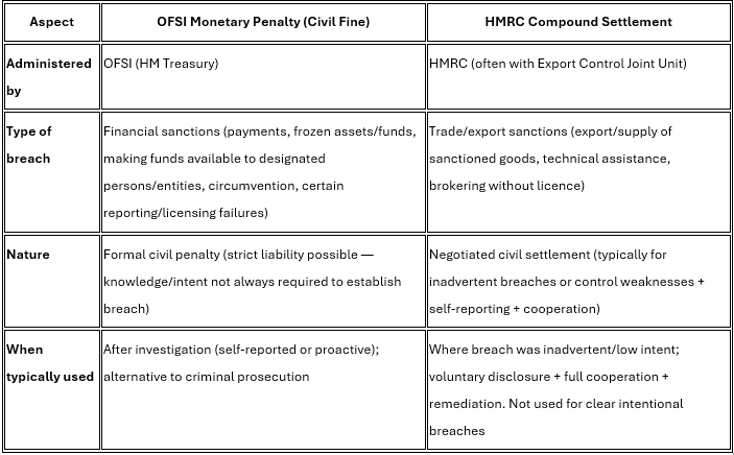
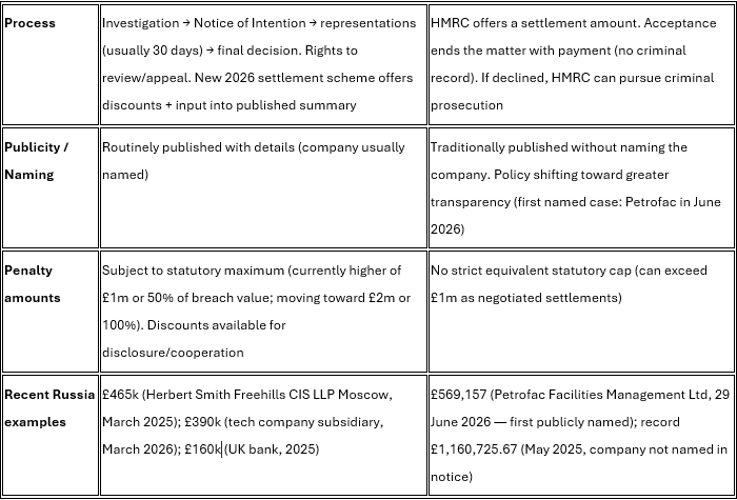
In short:
- Use OFSI for money/finance-related breaches.
- Use HMRC compound settlements for physical goods, exports, and trade-related breaches.
Both encourage self-reporting and are civil tools that avoid criminal prosecution in appropriate cases.
- A new Office of Trade Sanctions Implementation (OTSI) has civil penalty powers for some trade sanctions, but HMRC compound settlements remain the prominent mechanism highlighted in recent Russia trade cases.
Recent High-Profile Example (Petrofac)
- On 29 June 2026, Petrofac Facilities Management Limited (PFML) — an Aberdeen-based former Petrofac subsidiary — paid a £569,157 HMRC compound settlement.
- This was the first company publicly named by HMRC in such a settlement. The breaches (supply of sanctioned industrial goods and technical assistance in 2022–2023 while winding down Russian operations) were self-reported and the company cooperated fully. HMRC has signalled that public naming may become a standard condition in future compound settlements for strategic exports and sanctions offences — marking a clear shift toward greater transparency.
The regime continues to evolve.
- For the absolute latest designations or individual penalty notices, check the gov.uk sanctions pages directly, as updates occur frequently.
Primary Official Sources (for verification and further reading)
- UK Sanctions List (single source for designations): https://www.gov.uk/government/publications/the-uk-sanctions-list
- OFSI Annual Review 2024–25 (enforcement statistics and trends): https://www.gov.uk/government/publications/ofsi-annual-review-2024-25-effective-sanctions/ofsi-annual-review-2024-25-effective-sanctions
- OFSI Enforcement and Monetary Penalties Guidance: https://www.gov.uk/government/publications/financial-sanctions-enforcement-and-monetary-penalties-guidance/financial-sanctions-enforcement-and-monetary-penalties-guidance
- UK Government strategic approach to sanctions enforcement (explicit distinction between OFSI penalties and HMRC compound settlements): https://www.gov.uk/government/publications/sanctions-enforcement-cross-government-approach-march-2026/uk-governments-strategic-approach-to-sanctions-enforcement
- HMRC sanctions enforcement actions and case studies: https://www.gov.uk/government/collections/sanctions-enforcement-action
The Team
Meet the team of industry experts behind Comsure
Find out moreLatest News
Keep up to date with the very latest news from Comsure
Find out moreGallery
View our latest imagery from our news and work
Find out moreNews Disclaimer
As well as owning and publishing Comsure's copyrighted works, Comsure wishes to use the copyright-protected works of others. To do so, Comsure is applying for exemptions in the UK copyright law. There are certain very specific situations where Comsure is permitted to do so without seeking permission from the owner. These exemptions are in the copyright sections of the Copyright, Designs and Patents Act 1988 (as amended)[www.gov.UK/government/publications/copyright-acts-and-related-laws]. Many situations allow for Comsure to apply for exemptions. These include 1] Non-commercial research and private study, 2] Criticism, review and reporting of current events, 3] the copying of works in any medium as long as the use is to illustrate a point. 4] no posting is for commercial purposes [payment]. (for a full list of exemptions, please read here www.gov.uk/guidance/exceptions-to-copyright]. Concerning the exceptions, Comsure will acknowledge the work of the source author by providing a link to the source material. Comsure claims no ownership of non-Comsure content. The non-Comsure articles posted on the Comsure website are deemed important, relevant, and newsworthy to a Comsure audience (e.g. regulated financial services and professional firms [DNFSBs]). Comsure does not wish to take any credit for the publication, and the publication can be read in full in its original form if you click the articles link that always accompanies the news item. Also, Comsure does not seek any payment for highlighting these important articles. If you want any article removed, Comsure will automatically do so on a reasonable request if you email info@comsuregroup.com.
Archived News
To find our older articles, please click here.
View archive

To find our older articles, please click here.