

Update - JFSC Countries and territories in appendices D2 AML/CFT/CPF Handbook – 2 April 2026
12/04/2026
The JFSC has updated Appendix D2 of the JFSC AML/CFT/CPF Handbook to support FIRM in identifying any countries, territories, and areas linked to higher risks of ML/TF/PF. The changes (dated 2 April 2026, published 10 April 2026) are purely mechanical and driven by updates to the underlying external third-party sources.
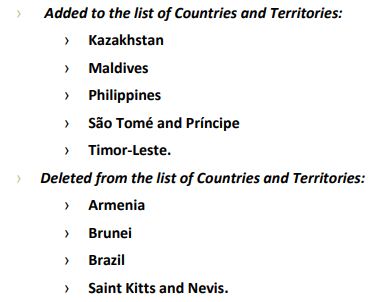
Added to the list of Countries and Territories:
- Kazakhstan
- Maldives
- Philippines
- São Tomé and Príncipe
- Timor-Leste.
Deleted from the list of Countries and Territories:
- Armenia
- Brunei
- Brazil
- Saint Kitts and Nevis.
Exact triggers for each change (from the official JFSC amendments log)
Added to the higher-risk list (now flagged by at least one source):
- Kazakhstan → triggered by Source 11 (OECD Peer Review of Automatic Exchange of Financial Account Information).
- Maldives → triggered by Source 8 (Basel AML Index).
- Philippines → triggered by Source 9 (World Bank Worldwide Governance Indicators).
- São Tomé and Príncipe → triggered by Source 8 (Basel AML Index).
- Timor-Leste → triggered by Source 8 (Basel AML Index).
Deleted from the higher-risk list (no longer meets the threshold in the relevant source(s)):
- Armenia → removed from Source 12 (UK Government arms embargoes and other trade restrictions).
- Brunei → removed from Source 4 (US State Department 2025 Trafficking in Persons Report).
- Brazil → removed from Source 9 (World Bank Worldwide Governance Indicators).
- Saint Kitts and Nevis → removed from Source 8 (Basel AML Index).
(For reference, Source 8 is the Basel AML Index from the Basel Institute on Governance; Source 9 is the World Bank WGI; Source 11 is the OECD global forum peer review on tax transparency/exchange of information; Source 12 is the current UK sanctions/arms embargo list. No changes occurred in FATF Sources 1 or 2 this time.)
THE JFSC SAYS
FIRMS are expected to exercise judgment when interpreting these sources and reaching conclusions on risks.
FIRMS
- MUST review policies, procedures, and existing customer relationships, to assess the impact of these updates on your business
- MUST take particular care when considering placing reliance on an obliged person based in one of these countries and territories
- MAY be required to undertake additional actions to mitigate the risk.
The JFSC Appendix D2
- PROVIDES a detailed overview of countries identified as higher risk by reliable and independent external third parties, such as the Financial Action Task Force, UN, OECD, World Bank, US Department of State, UK Government, and others.
- is not a JFSC-generated risk rating. It simply compiles and cross-references flags from 14 established external sources. The JFSC reviews these sources regularly (FATF lists after each plenary meeting ~3x per year; many other indices are published annually, often in Q1). When a country’s status changes in one or more of those sources, the JFSC updates the appendix accordingly. No new sources were added or removed in this update the changes stem solely from shifts in the latest data/publications of the existing sources.
SOURCE
The Team
Meet the team of industry experts behind Comsure
Find out moreLatest News
Keep up to date with the very latest news from Comsure
Find out moreGallery
View our latest imagery from our news and work
Find out moreContact
Think we can help you and your business? Chat to us today
Get In TouchNews Disclaimer
As well as owning and publishing Comsure's copyrighted works, Comsure wishes to use the copyright-protected works of others. To do so, Comsure is applying for exemptions in the UK copyright law. There are certain very specific situations where Comsure is permitted to do so without seeking permission from the owner. These exemptions are in the copyright sections of the Copyright, Designs and Patents Act 1988 (as amended)[www.gov.UK/government/publications/copyright-acts-and-related-laws]. Many situations allow for Comsure to apply for exemptions. These include 1] Non-commercial research and private study, 2] Criticism, review and reporting of current events, 3] the copying of works in any medium as long as the use is to illustrate a point. 4] no posting is for commercial purposes [payment]. (for a full list of exemptions, please read here www.gov.uk/guidance/exceptions-to-copyright]. Concerning the exceptions, Comsure will acknowledge the work of the source author by providing a link to the source material. Comsure claims no ownership of non-Comsure content. The non-Comsure articles posted on the Comsure website are deemed important, relevant, and newsworthy to a Comsure audience (e.g. regulated financial services and professional firms [DNFSBs]). Comsure does not wish to take any credit for the publication, and the publication can be read in full in its original form if you click the articles link that always accompanies the news item. Also, Comsure does not seek any payment for highlighting these important articles. If you want any article removed, Comsure will automatically do so on a reasonable request if you email info@comsuregroup.com.


As well as owning and publishing Comsure's copyrighted works, Comsure wishes to use the copyright-protected works of others. To do so, Comsure is applying for exemptions in the UK copyright law. There are certain very specific situations where Comsure is permitted to do so without seeking permission from the owner. These exemptions are in the copyright sections of the Copyright, Designs and Patents Act 1988 (as amended)[www.gov.UK/government/publications/copyright-acts-and-related-laws]. Many situations allow for Comsure to apply for exemptions. These include 1] Non-commercial research and private study, 2] Criticism, review and reporting of current events, 3] the copying of works in any medium as long as the use is to illustrate a point. 4] no posting is for commercial purposes [payment]. (for a full list of exemptions, please read here www.gov.uk/guidance/exceptions-to-copyright]. Concerning the exceptions, Comsure will acknowledge the work of the source author by providing a link to the source material. Comsure claims no ownership of non-Comsure content. The non-Comsure articles posted on the Comsure website are deemed important, relevant, and newsworthy to a Comsure audience (e.g. regulated financial services and professional firms [DNFSBs]). Comsure does not wish to take any credit for the publication, and the publication can be read in full in its original form if you click the articles link that always accompanies the news item. Also, Comsure does not seek any payment for highlighting these important articles. If you want any article removed, Comsure will automatically do so on a reasonable request if you email info@comsuregroup.com.